If you've ever been handed a quote for a Hobart 60 qt mixer and felt your chest tighten, this article is for you. I've spent 14 years on the buying side of these decisions. I manage equipment budgets for a 90-person food manufacturer, and I've tracked every invoice in our cost system since 2018. I also run the maintenance shop that fixes mixers, grinders, and welders when they break. So I know both numbers: what equipment costs on paper, and what it costs when it's sitting on a workbench waiting for a part.
I'll be honest: the Hobart 60 qt mixer price is not a sexy topic. Unless you're a baker, a foodservice manager, or a maintenance supervisor, you have no reason to care. But if you are one of those people, the way you think about that price is probably backwards.
The sticker shock is real, and it's the wrong problem
The first reaction to any Hobart quote is usually 'How much?' The second reaction is 'What else can we buy instead?' I get it. Budgets are real. I have a boss who asks me why we can't buy the cheaper model every single year.
The problem isn't that Hobart is expensive. The problem is that we compare equipment the same way we compare phone plans: by the monthly price. Commercial equipment needs a different math. A mixer that runs two batches of dough on a Saturday morning is not the same machine as a mixer that runs three shifts. The purchase price is one small piece of the real cost.
What's actually going on beneath the quote
When I audit our 2023 spending, I can see the real pattern. The purchases that made me look smart weren't the cheapest ones. They were the ones that never came back for repairs. The ones that ate our maintenance budget were almost always the ones selected because the price was low.
Why does that keep happening? Because we use the wrong comparison. Here are the pieces that a line-item quote doesn't show:
- Duty cycle: Is the machine built for continuous commercial use, or for occasional use?
- Installation: Does it need three-phase power, a dedicated circuit, a vent hood, or a reinforced floor?
- Parts: How fast can you get a gear, a paddle, a liner, or a gun?
- Service knowledge: Can a normal technician repair it, or does it require a specialist? Is there a training network?
- Downtime: What does an hour of lost production cost you? Not just labor, but the delivery you miss.
That last one is the killer. The price quote is just the entrance fee. When a machine goes down, the clock keeps running. In our plant, an hour of idle kitchen line time is more than a repair bill. It's the wholesale order that didn't ship.
People say 'you're paying for the name.' The causation runs the other way.
I hear this a lot: 'Hobart just charges more because of the brand.' Actually, I think it's the reverse. Hobart can charge what it does because the machines have earned a reputation in kitchens and shops that run hard. The brand is the result, not the cause. That's not a marketing theory. It's a service-parts reality. The same company that sells the mixer also stocks the gear and has a technical support line. That has value when you're down.
This is exactly how I think about Hobart meat grinders too. The grinder head price is a small part of the story. The real cost is in the gear reduction, the cutting assembly, and the ability to get a replacement plate without waiting two weeks. If the grinder is in a busy prep line, that availability is everything.
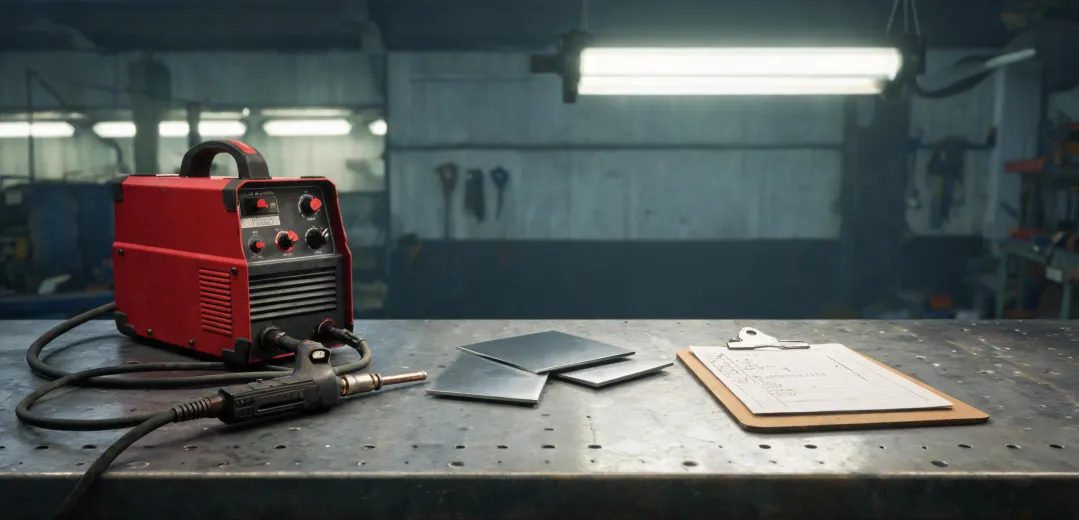
Welding equipment follows the same logic. Our maintenance shop has an orange welding machine—a Hobart MIG unit—that we use for everything from cart repairs to light fabrication. A MIG gun welder can look like a bargain on paper. Then you add gas, wire, tips, liners, and the time it takes your guy to tune the settings. The real cost isn't the machine. It's how much usable weld you get per hour.
Even when someone asks me about a wire mesh welding machine price, I steer them back to the same list. That machine might be cheap to quote but expensive to run if the controllers don't match your mesh spacing or the wire feed jams. Price and cost are different numbers.
The surprise wasn't the price difference. It was the hidden value.
I remember a comparison I ran in Q2 2024. We had two quotes in front of us: one for a 60 qt Hobart mixer and one for a budget model at roughly 35% less. By every spec sheet, the budget model looked close. But when I added the voltage upgrade, the bowl guard, the longer warranty, and the fact that the Hobart dealer included setup and a walkthrough, the gap shrank to about 12%. And the budget model still didn't explain how fast we could get parts.
We bought the Hobart. The surprise wasn't that it worked. The surprise was how much of a non-event it was. The installation went smoothly. There was no issue with training the operator. The first time it needed a routine part, the local dealer had it in stock. That's a ton of value that never shows up on an invoice.
I should be careful here. I'm not saying every business should buy a 1,200-pound Hobart mixer or a production-class welding rig. Our situation is an industrial kitchen with a maintenance shop that works on food equipment. If you're a small bakery doing a few batches a week, a lighter commercial mixer could be the right call. If you're a fabricator doing weekend jobs, a lower-duty MIG welder might make more sense. Context matters. The formula matters more than my recommendations.
Not solving the problem gets expensive fast
I've made this mistake too. The first time I approved a budget grinder, I thought I was being clever. I wasn't. It failed during a holiday production week, and the repair took longer than the savings. I've also seen the cheap option cause a $1,200 redo when quality failed. The real cost of buying on price isn't the repair bill. It's the phone call you have to make. It's the recipe you can't finish. It's the employee standing by the machine with nothing to do.
The cheapest machine in the catalog is only cheap if it stays running. Once it fails, the cost formula changes. And several of those changes are things you can't control: a part that's discontinued, a supplier that takes four weeks, a service tech who has never seen the machine.
So what should you do? Stop comparing price, start comparing total cost.
The fix isn't complicated. Build a simple spreadsheet. Put the purchase price at the top, then add the cost of installation, a maintenance estimate, the downtime risk for your particular operation, and the expected life of the machine. Compare five-year totals, not 30-day invoices.
If you're looking at a Hobart 60 qt mixer, ask the dealer for an itemized quote that includes delivery, setup, and any electrical work. In 2024, dealer quotes I saw for a 60 qt Hobart ranged from about $14,000 to $22,000 depending on configuration, so don't trust a one-line number. As of January 2025, Hobart still sells through dealers rather than publishing fixed list prices for most commercial kitchen equipment. That's another reason to get a written spec. Verify current pricing with your local Hobart dealer.
For Hobart meat grinders, compare the cutting assembly cost and parts availability. For a MIG welder, compare wire feed reliability, the price of a replacement gun, and gas availability. For a wire mesh welding machine, compare controller flexibility and support. The question is never 'What does it cost?' The question is 'What does it cost me over five years?'
That's the bottom line. It's not a game-changer, and I'm not pretending I invented it. But in 14 years of procurement, it's the only approach that has saved me from buying something cheap twice. Price is what you pay. Cost is what you live with.
Price is what you pay. Cost is what you live with.