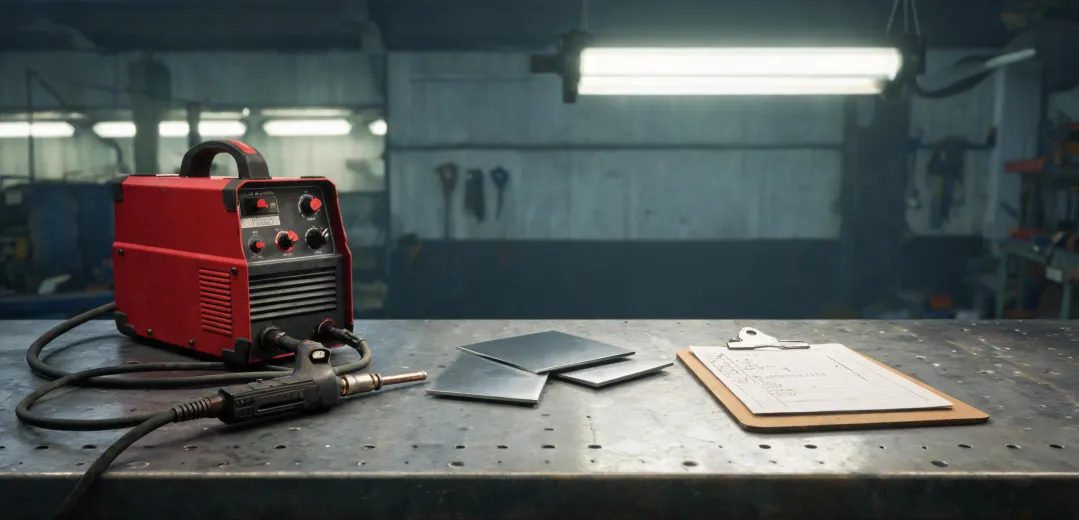
If you're reading this because you searched for 'vintage hobart meat grinder', 'hobart 2812 meat slicer', or any welding-related keyword, here's the uncomfortable truth: there is no single right answer. The right machine depends on how you're going to use it, who's going to operate it, and what's actually included in the price.
I've spent 8 years handling equipment orders for foodservice and metal fabrication clients. I've personally made (and documented) 14 significant mistakes, totaling roughly $26,000 in wasted budget. Now I maintain our team's checklist to prevent others from repeating my errors.
Here are the three scenarios I keep walking into. Each needs a different decision rule.
Scenario 1: You're staring at a vintage hobart meat grinder
I love these machines. The cast iron, the enamel, the fact that they outlived their original owners. But 'vintage' and 'trustworthy' are not the same sentence. The mistake I made in my first year (2017) was buying a restored #32 for a client based on photos. It looked beautiful. The worm housing was cracked and had been brazed badly. The first test run jammed.
$1,200, plus a 6-week repair wait, straight to the trash.
The lesson: if you're restoring one for looks, fine. If you're going to grind meat for sale, budget for a teardown inspection before you pay. Ask the seller for photos of the worm, the housing, and the feed screw. The two sizes worth chasing are #10 and #32. A #10 is enough for occasional batches; a #32 is a production tool. Most buyers focus on the paint and the brand and completely miss whether replacement parts are actually available.
And if the listing says 'great condition' but won't show the inside, walk. I've learned to ask 'what's NOT included' before 'what's the price.' That single question has saved our team more money than any negotiation.
Scenario 2: You need a Hobart 2812 meat slicer for a working kitchen
If you searched 'hobart 2812 meat slicer' because someone told you it's the last slicer you'll buy, that's kind of true—the 2812 is a heavy-duty commercial slab. But 'buy once' doesn't mean 'buy used once.'
Used slicer prices are appealing. I once ordered a 2812 for a catering company without checking the service record. It arrived with a dished blade and a carriage that stuck at the end of each stroke. Reconditioning cost $450, plus a week of downtime. When I compared the used-plus-repair cost with the new-with-warranty cost side by side, I finally understood why the details matter so much. The 'deal' was 60% of the way to the price of new.
Here's the thing: if this is your only slicer and you're slicing every day, a used one is a gamble unless the seller can show a blade replacement history and a carriage inspection. The question everyone asks is 'how much for the slicer?' The question they should ask is 'what's the service record, and what's not included in the warranty?'
It took me 3 years and about 150 orders to understand that used equipment is only a deal if the service record is part of the price.
Scenario 3: You're choosing a welding machine
Welding machines are where I've made my most expensive mistakes. Actually, they weren't mistakes about the machines. They were mistakes about the context. You need to figure out which one of these three you're in.
3a. The 'elite welding machine' temptation
Look, I'm not saying high-end multi-process welders are bad. An elite welding machine—with pulse settings, TIG controls, and a color display—can be a great tool. The problem is when it's the wrong tool.
Every spreadsheet analysis said I should buy the feature-packed unit because it covered MIG, TIG, and stick. My gut said keep it simple. That time, the numbers won. Turns out my gut was detecting something the spreadsheet didn't have a column for: consumable costs and repair complexity. The maintenance costs erased the savings from combining three machines into one.
If you're regularly switching between materials and processes, get the elite machine. If 80% of your work is MIG wire on mild steel, buy a dedicated MIG machine and save the difference for gas and nozzles. Simple.
3b. The 'ship welding machine' requirement
Ships are a different animal. A ship welding machine has to handle long duty cycles, hot ambient temperatures, and long cable runs. I once sourced a portable inverter for a small yard job because the max amps looked sufficient. It thermal-throttled after 20 minutes of continuous fillet welding. The redo cost $2,100 and my client missed a tide window.
If you're welding in a shipyard, don't shop by max output. Shop by duty cycle at 60% and by the class of cable included. Ask whether the quote includes the remote control, the ground cable, and all the things that rust. Because on a ship, 'cheap' corrodes fast.
3c. The laser welding machine bed mistake
Now the one I wish I'd documented earlier. A laser welding machine bed is not just a table. It's a workholding system, a heat sink, and part of the weld circuit. I ordered one without verifying how the slats would hold thin sheet. The workpieces shifted under clamping and the welds looked like bad handwriting. It took me two days to realize the bed was the problem, not the laser.
If you're setting up a laser welding machine bed, spend the money on adjustable clamping, copper backing, and a leveling system. That's where the quote gets vague. I've learned to demand a list of every item included before I sign. Because after the third rejection in Q1 2024, I created our pre-check list. It has caught 47 potential errors in the past 18 months.
How to tell which scenario you're in
Still not sure? Ask these four questions, in this order:
- Will this machine run every day? If yes, lean new or certified refurbished with a warranty. If it's for a side project, vintage and used are fine—but budget for repair.
- Does the seller show what's worn? A transparent seller lists the flaws. If you have to ask 'what's not included,' you'll probably find out at the worst moment.
- What is the duty cycle in my environment? That's the real spec for a ship welding machine. For an elite welding machine, ask whether the extra features generate revenue or just eat consumables.
- Is the accessory priced honestly? For a laser welding machine bed, ask for slat material, clamps, leveling feet, and backing bars as line items. If they're not line items, they're hidden costs.
Here's what I've landed on after all the mistakes: the machine matters, but the agreement matters more. Trust me on this one. The vendor who lists every fee up front—even when the total looks higher—usually costs less in the end. I've come to believe that 'best price' is a phrase to avoid. Ask instead, 'what's the complete price, and what will void the warranty?' That question has caught more errors than any spec sheet. That's the checklist. That's it.