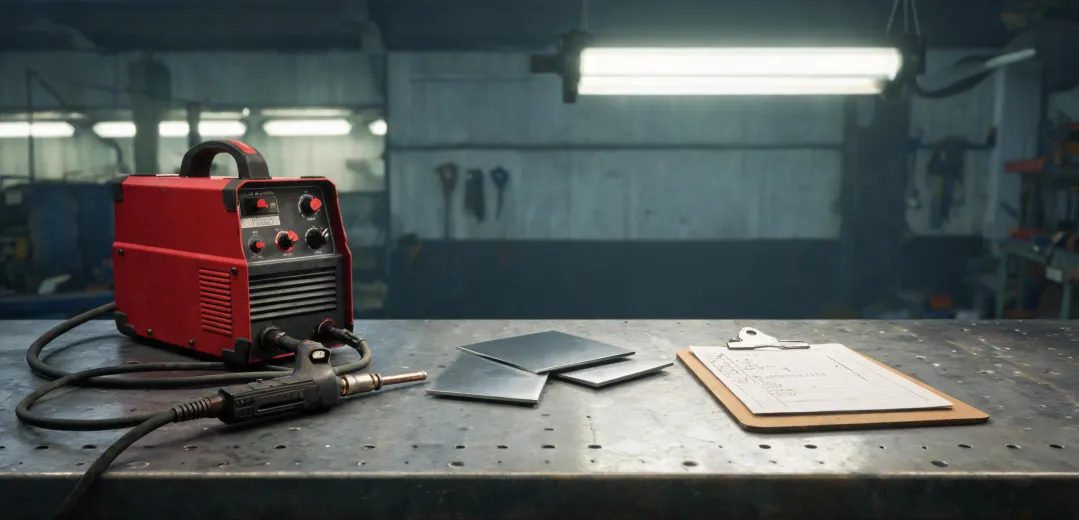
My first big purchasing mistake in a metal shop was buying a welder the way you buy a toaster.
Compare prices. Pick the cheap one. Go home. That approach cost me $1,400 in wasted labor on a single job, and I'm not even counting the consumable costs. That's when I learned the hard truth: the cheapest welding machine you can buy is usually the most expensive one to own.
I now run a small fabrication operation, and I've personally made (and documented) more than 20 equipment buying errors over the past six years, totaling roughly $8,000 in wasted budget. This is the one I keep telling new guys about, because it was the most preventable.
I Bought the Bargain MIG Welder. It Looked Perfect on Paper.
In early 2022, I needed a MIG welder for light repair work. I found a budget unit with decent amperage, a reasonable wire feed range, and a price that undercut the known brands by a mile. It was in the same class as a Harbor Freight Titanium MIG 170, and I thought I was being smart.
I wasn't.
By the third week, the pattern was clear. The machine ran hot for a few minutes, then the thermal overload kicked in. I'd wait. Weld for two minutes. Wait again. A $3,400 restaurant equipment repair that should have taken three hours took me six. The customer was patient. The billable hours were not.
Nobody told me about the duty cycle. Not the product page, not the reviews, not the packaging.
That's when I learned to ask a question I'd never thought to ask before: "What's NOT included?"
In my opinion, that's the entire conversation about welding equipment — whether you're using a MIG-only welder, a stick arc welder, a TIG rig, or a plasma cutter. The question isn't the price. It's what's hiding behind the price.
What "Not Included" Actually Means
When I say "what's not included," I don't just mean accessories. I mean:
- Duty cycle that lets you actually finish a job
- Consumables that don't burn through your budget
- Replacement parts you can find when you need them
- Support that gives straight answers
- Honest specs with stated limitations, not cherry-picked numbers
My budget welder failed on almost every count. The consumables were low quality, the replacement tips took two and a half weeks to arrive, and the support email was a black hole. The machine worked in the most literal sense, but owning it was a slow leak of time and money.
It's tempting to think a MIG welder is a MIG welder — that the machine with the same amperage rating will perform the same. It doesn't work that way. The same numbers on paper don't mean the same performance in your hands, under load, for hours.
To be fair, the Harbor Freight Titanium MIG 170 is a decent budget machine for its intended audience. I'm not trying to trash it. But if you're using that class of welder commercially without knowing the limitations, you're going to get burned. I did.
Consumables Are the Quiet Budget Killer
Here's what most first-time buyers completely miss: the machine is the down payment. Consumables are the monthly payment.
Tips, contact tips, liners, nozzles, wire. They wear out and need replacing. And the frequency depends heavily on the quality of the machine and parts you feed it.
With my budget welder, I was replacing tips far more often than I should have, because the liner was mediocre and the wire would jam. Every jam meant pulling the gun apart, clearing the liner, and usually wrecking a tip. I wasn't just losing money on consumables — I was losing time, and time is what I actually sell.
That's one reason I shifted to brands that make documentation easy to find. The Hobart portal, for instance, lets you look up parts, manuals, and service information by model and serial number. It sounds boring until you've tried to find a replacement liner for a no-name machine from a seller who barely responds to emails.
The "MIG-Only" Question Isn't the One You Should Be Asking
There's a weird assumption I keep hearing: that a MIG-only welder is somehow less than a multi-process machine.
I'd argue the opposite is often true.
A dedicated MIG-only welder that's honest about what it does — and does it consistently — can be the better purchase. The multi-process machine that claims to do MIG, stick, and TIG in one box often compromises on all three. You get a jack-of-all-trades that's master of none.
The real problem isn't the "MIG only" label. It's when limitations are buried in a PDF or left out entirely, so you buy expecting one thing and get something else.
That applies to arc welders too. A welding arc welder — whether stick, MIG, or TIG — is only as valuable as its reliability and the honesty of its spec sheet. If a machine has a 20% duty cycle, that should be on the front page of the product listing, not hidden in a manual nobody downloads.
This principle is exactly why I ended up with a Hobart 250CI plasma cutter. It wasn't the cheapest option I evaluated. Let me be direct about that. But the spec sheet was complete, the torch was matched to the machine, the cut ratings seemed realistic, and I could get a straight answer before I spent the money. Hobart has been around welding long enough that they run an actual welding institute — that institutional knowledge shows up in the way they document their equipment.
The "But I Only Weld on Weekends" Argument
I can hear the pushback: "Do I really need to spend Hobart money if I only weld occasionally?"
Honestly? Maybe not.
If you're a weekend fabricator doing light repairs, a budget machine from Harbor Freight or similar could be the right tool. At low duty cycles and short sessions, the limitations matter less. Replacement parts being slow is less painful when you're not watching the clock.
My problem was never with budget brands. It's with the way they're often sold — as if they're the same as professional equipment, just cheaper. They aren't. And when you buy them under that assumption, you end up either disappointed, or paying more in downtime and rework than you saved.
So if you go the budget route, go in with your eyes open. Ask about the duty cycle. Ask what consumables cost. Ask if you can actually buy a replacement liner. The answers might make you uncomfortable. In my experience, that discomfort is useful information.
Rough Math on Total Cost
Take this with a grain of salt, because every situation is different. But from my spreadsheets, a budget machine used commercially will cost you 25–40% of its purchase price again in consumables, repairs, and rework within the first year. Sometimes more.
With the Hobart 250CI, I planned for that in the budget and got a machine that actually does what I need it to do, with documentation and parts availability. I'm not guessing at the total cost of ownership. I can calculate it.
That, to me, is what transparent pricing really means: not just the number on the machine, but a full picture of what it costs to run the machine.
What I'd Tell a First-Time Buyer
If you're shopping for a welder — MIG, arc, TIG, or a plasma cutter like the Hobart 250CI — here's the checklist I keep on our team's board:
- Find the official spec sheet. Look specifically for duty cycle and recommended use cases.
- Find the consumables for that model. What do they cost? Are they in stock anywhere?
- Call or email the manufacturer with a specific question. If they can't answer it clearly, that's a red flag.
- Add 20–30% to the sticker price as a rough estimate of real-world setup and ownership costs. Compare totals, not sticker prices.
That last step changes everything. It turns "cheapest welder" into "most honest total cost."
I wish I'd done it in 2022. It would have saved me $1,400 and a lot of embarrassment.
So I'll leave you with the same question I now ask before every piece of equipment: What's not included? The answer tells you everything the price tag doesn't.