Six years ago, when I took over procurement for our food processing company, I made the mistake of buying the cheapest equipment I could find. I thought that's what a good cost controller did. Then a "bargain" slicer cost us $1,200 in redo work, and I learned the difference between spending little and spending smart.
I now manage roughly $180,000 in annual equipment spending, track every invoice in a dashboard I built after getting burned on hidden fees twice, and evaluate every purchase on total cost of ownership (TCO), not sticker price.
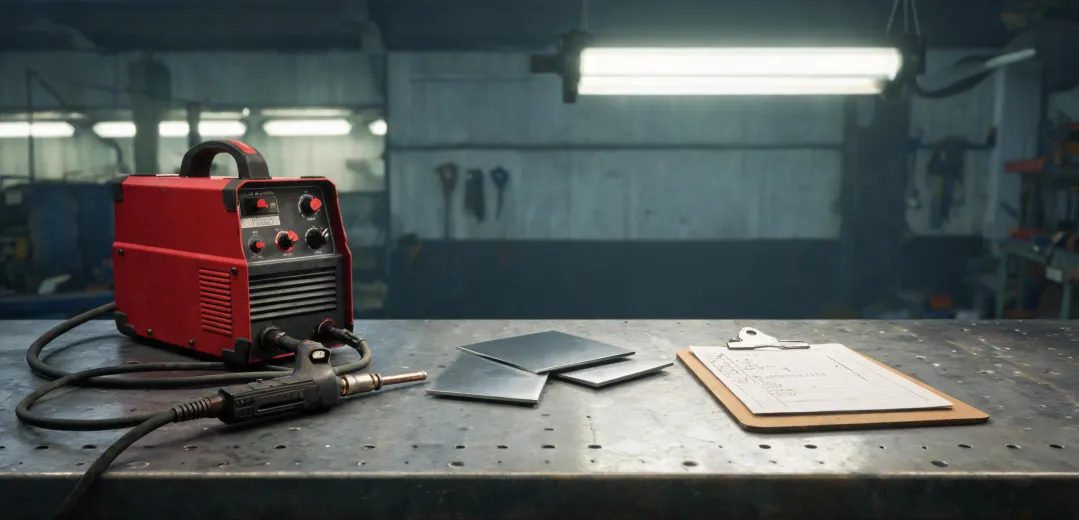
So when our operations manager found a listing for a used Hobart meat grinder for sale at half the price of a new Hobart 4732 meat grinder, I didn't approve it or reject it. I ran the same comparison I'd run for the Lorch MIG welder we were considering for fabrication work, and the TIG DC welder alternative. This article is that comparison—four dimensions: upfront price, TCO, reliability, and support.
The verdict? Used won on one dimension, tied on a second, and lost badly on the other two. But the details are not the same for grinders as they are for welders.
The Price Gap Is Real—But It Shrinks Fast
A new Hobart 4732 meat grinder runs roughly $6,800 to $7,500 depending on configuration and dealer, based on pricing I checked in December 2024. The used market is all over the place: I've seen listings from $2,200 for auction units to $4,000 for one with documented service history.
The welding side follows a similar pattern. A new Lorch MIG welder—the model we evaluated—lands around $3,500 including the torch and regulator. Hobart's own welding line has comparable units with similar pricing, by the way. A used TIG DC welder from a reputable brand can be found for $800 to $1,800 depending on age and condition.
On sticker price alone, used wins. No contest. But I've learned the hard way that sticker price is the least useful number in procurement. We bought a used slicer in 2023 for $1,400—or rather, $1,400 plus $160 delivery, plus $520 in parts before it ran right. Total: $2,080. A new unit was $2,600 with a warranty. The savings evaporated.
Dimension conclusion: Used wins on upfront price, but the gap closes fast once you factor in the cost of making an old machine production-ready.
Total Cost of Ownership—Where Used Loses Ground
The Hobart 4732 has one of the best parts networks in the commercial equipment industry. You can still order grinding plates, knife sets, and bearings for machines from the 1980s. But "you can order them" and "they're cheap" are different statements. A full set of plates and knives runs $250–$400. Gearbox work runs $800–$1,200 with labor.
That's not hypothetical. In Q2 2024, we spent $950 repairing a used grinder we'd owned for 14 months, and it was down for nine days. For a food operation, downtime means expedited orders, refunded deliveries, and one very unhappy operations manager.
Welding equipment has the same dynamic in different clothing. Used welders often come with worn liners, damaged torch leads, or capacitors on their last legs. A replacement welder MIG torch cutter kit runs $150–$400 depending on whether you choose OEM or aftermarket parts. Electrical failures on used machines can cost more to diagnose than the machine is worth.
Here's the rule I use now: take the used price, add 20–25% as a repair buffer, and compare the total to new. If the gap is under 30%, buy new. Applying that to the Hobart 4732: used at $3,000 plus a $750 buffer equals $3,750—still cheaper than new. For welding, a used TIG DC welder at $1,200 plus a $300 buffer was roughly 60% cheaper than the new Lorch MIG setup. Different math, different answer.
Dimension conclusion: Used equipment makes sense only when the post-repair total stays significantly below new—and that's more often true for welding gear than for food-contact equipment.
Reliability and Lifespan—The "They Don't Make Them Like They Used To" Myth
The most persistent belief in commercial kitchens is that old Hobart machines are indestructible. There's real truth there. The Hobart 4732's cast aluminum housing and worm gear drive are genuinely overbuilt. I've seen 20-year-old units that run as well as the day they were installed.
But the "old = better" thinking comes from an era when the alternative was flimsy consumer-grade equipment. Today, that's changed. Modern commercial grinders use food-grade stainless steel on contact surfaces, have better safety guards, and meet current NSF sanitation standards. Try explaining to a health inspector that your vintage grinder's cracked throat housing is "fine because it's a Hobart." I did. It didn't end well.
Welding has a parallel story. Older transformer-based welders are tough but inefficient, and they lack the arc control of modern inverter units. A used TIG DC welder from a decade ago will run—until you need pulse control or the flexibility for different materials. That's when the Lorch MIG unit we eventually purchased justified its price.
The nuance most people miss: reliability is a maintenance question, not an age question. A used unit with documented service history can outrun a new unit that sat in a warehouse for years. But an unverified used machine is a gamble—and for food-contact equipment, it can cost you in ways that don't show up on a spreadsheet.
Dimension conclusion: Age alone doesn't determine reliability. Maintenance history does. And the consequences of failure are higher in food service.
Warranty and Support—The Biggest Reason to Buy New
New Hobart equipment, as of January 2025, includes a one-year parts and labor warranty through authorized service centers. I'm not 100% sure whether recent terms have changed, so verify with your dealer. The deeper value is the infrastructure: authorized dealers stock parts, employ trained technicians, and typically get machines back online within days.
Used equipment is almost always sold as-is. The previous owner may be honest about condition, or may not. We bought a used grinder from a closing restaurant in 2023. The owner said it "worked fine." It did—until it didn't, three weeks later. The repair bill consumed most of our savings.
If you're a smaller operation, I've noticed a pattern of assuming used is the only realistic option because new equipment "is for the big guys." That hasn't been my experience. We started as a six-person team, and the vendors who treated our $200 orders seriously are the ones we still use for $20,000 orders. Some dealers offer open-box or demo units at reduced prices, and many are willing to work with a small business buyer—they're betting on your growth, and more often than not, they're right.
I'll acknowledge the contradiction: I'm a cost controller, and I'll pay for warranty coverage on food-contact equipment without hesitation. Rush repair fees, though? Those I have mixed feelings about. Part of me thinks they're gouging when a machine dies at 4 PM on a Friday. Another part recognizes the operational chaos that one broken grinder causes during a production run. Maybe the premium is the price of certainty.
Dimension conclusion: Support infrastructure is the strongest argument for buying new—especially in food service. Welding rigs, if you can service them yourself, are more forgiving.
What I'd Buy New, What I'd Buy Used
After comparing eight vendors over three months last year on the grinder purchase—our procurement policy now requires three quotes minimum because hidden costs keep appearing where we least expect them—here's the practical guidance I'd give anyone in a similar position:
Buy used when:
- You can inspect the equipment in person and run it before paying.
- The seller can produce a documented maintenance history.
- The equipment doesn't touch food directly, or you're prepared for a full sanitization and refurbishment.
- The price gap after your 20–25% repair buffer is still substantial.
Buy new when:
- The equipment touches food. A grinder's sanitation profile matters more than its gearbox.
- You need warranty coverage for compliance or insurance reasons.
- The price difference after the repair buffer is under 30%. The warranty is worth at least that.
- Financing on new equipment makes the cash flow roughly equivalent for the first year.
For welding specifically: if you're deciding between a used TIG DC welder and a new MIG setup with a torch and cutter kit, be honest about your own capabilities. A used machine you can maintain yourself is a reasonable bet. A used machine that requires a certified technician is a recurring cost you haven't budgeted for.
The bottom line: new versus used isn't a moral question, and it's not about "big business vs. small business." It's a total cost question. Run the numbers, add the buffer, factor in downtime, and decide based on the complete picture—not the sticker price.