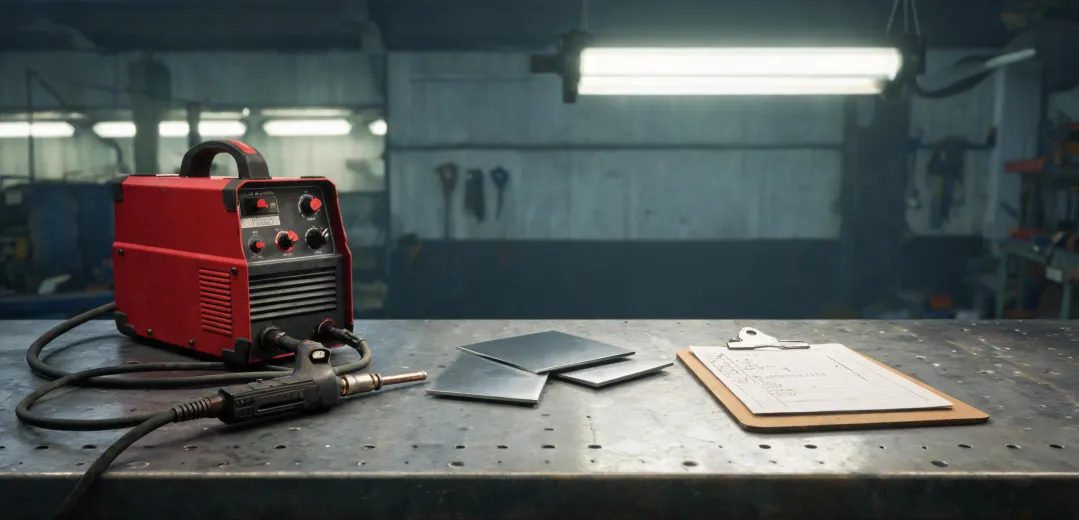
If you're running emergency repair calls, the Hobart 210 MVP MIG welder is the best first welding machine you can put in the truck. Not because it's the most powerful welder Hobart makes—it isn't. Because it runs on 120V or 240V, and in a crisis the only outlet you can count on is the one that's already there.
I'm a service coordinator for a small equipment repair company in the Midwest. Over the last nine years, I've handled around 300 emergency on-site jobs—kitchen equipment, food trailers, carts, gates, the occasional structural bracket. Maybe 260, if I'm being honest; I'd have to check the work order system. Last quarter alone, we processed 47 rush repair jobs with a 95% on-time completion rate. The pattern is the same: a client calls at 4:30 PM, something's broken, and it has to be welded before sunrise.
Why the Hobart 210 MVP MIG welder Is My Go-To
I didn't start with this machine. We had a bigger shop welder, and I assumed more power meant it would handle everything. It doesn't work that way on a deadline. In March 2024, a food truck operator called needing a door hinge welded the night before a health inspection. The truck was parked on a fairground with no 240V outlet within 75 feet. Dragging out the big machine wasn't an option. A small inverter unit with an extension cord kept tripping breakers. I remembered a Hobart 210 MVP MIG welder we'd sold to a customer a few months earlier. We borrowed it back. On 120V with .023 wire, it welded the hinge well enough that the inspector passed it. That one job paid for the machine.
What makes the 210 MVP different for emergency work is the dual-voltage input. You switch the voltage, plug into a regular wall outlet or a 240V outlet, and go. It's not a just barely works feature. On 120V, you have enough output for thin steel and stainless repairs. On 240V, you get more penetration and a better duty cycle for thicker material. If I'm triaging a rush order, I don't have time to ask an electrician to add a circuit. I'll take a lower output on 120V over no arc at all.
Hobart publishes the input requirements and duty cycle in the manual, so I'm not describing a hack or a modification. I want to say the output range is around 25 to 140 amps on 120V and 25 to 210 amps on 240V, but don't quote me on the low end—check the current spec sheet. The point is the machine is genuinely usable on both voltages.
The machine also has a familiar layout. My guys can set it up without reading the manual again. That matters when we're chasing a clock. I've spent time on other portable welders, and some of them have menus and settings that make you feel like you're programming a microwave. The 210 MVP is more direct. Set the wire speed, set the voltage, run a test bead, fix the job.
Pair It With a Hobart Auto Darkening Welding Helmet
Buy the Hobart auto darkening welding helmet at the same time. If you learned to weld by snapping your head down to trigger a fixed shade lens, this feels like a luxury. In emergency repair, it's not. It's speed and safety in one piece.
When I'm triaging a job, I've often got to line up the weld while the wire is already feeding. With a passive lens, you're working blind until you're confident about position. With the auto darkening lens, the shade goes dark almost instantly, so I can see my start point, pull the trigger, and watch the puddle form. It also kills the head-snap habit that wears on your neck after a long day of multiple calls.
One safety note: a helmet doesn't replace other PPE. I'm not a welding engineer, so I can't speak to the fume chemistry of every metal in an old food trailer. What I can tell you from a repair coordination perspective is to wear the helmet and a respirator in tight spaces. And if a job calls for a structural weld, get someone who's actually certified to sign it off. I'm the guy who gets you running again, not the one who approves code steel.
What About Genesis Welding Equipment and Zapp Welding Machines?
I get asked if cheaper machines are just as good. I've used some Genesis welding equipment on lighter shop work, and to be fair, it has a place. If you're doing bench repairs in a building with stable power and no rush, Genesis is worth a look for the price. But I wouldn't put it in my emergency truck. The 210 MVP's dual-voltage convenience and Hobart's support network have mattered more to me than the few hundred dollars I saved on other machines.
The Zapp welding machine is one I haven't spent enough time with to give a fair verdict. I've seen demos and read owner threads, but I don't trust that enough to recommend it for a job with a penalty clause. Maybe it's great. I just don't know, and I'd rather say that than pretend.
When a Gas or Diesel Welding Machine Is the Right Call
Here's the big exception to my advice. If your jobs take you where there is no power at all, then you're shopping for a gas or diesel welding machine. That's an engine-driven unit, and it's a different category. It's heavier, louder, more expensive, and it needs fuel. I use one when a client has a broken gate in a pasture or equipment sitting 50 yards from any building. On a job like that, a gas or diesel welding machine is the only tool that gets the deadline met.
That said, once I started carrying the 210 MVP, my engine drive usage dropped maybe 70%. Most no-power calls turned out to have a generator somewhere, an outlet behind a food stand, or an RV hookup. Not always. If you're doing pipeline or structural repair in open fields, ignore me and get the engine drive. For light commercial and food equipment repair, the 210 MVP covers the emergency cases eight times out of ten.
What I Learned After Skipping the Final Check
I'll give you a mistake instead of a victory story. A few years ago, we skipped the final weld inspection on a trailer bracket because we were behind schedule. The logic was classic overconfidence: it's basically the same as the last one. It wasn't. The bracket cracked, we had to go back, and the customer was furious. We paid $800 in overtime to fix it that night. That's when we created a pre-pickup checklist: test the machine, check the gas bottle, clean the ground clamp, tighten the liner, and verify the auto darkening helmet is charged. The checklist might sound boring, but it's the real deadline saver.
We didn't have a formal pre-job checklist for a long time. Cost us. The first time we skipped it, nothing happened. The second time, nothing happened. The third time, it happened. That's how the lesson landed.
The Real Cost of Emergency Readiness
I'll close with a pricing thought. When I'm building a truck setup, I try to list every cost upfront: the Hobart 210 MVP MIG welder, the Hobart auto darkening welding helmet, gas bottle, regulator, wire, spare tips, a decent ground clamp, and a generator if I know I'll need one. That number looks bigger than the welder's sticker price, but it's the real number. I've learned to ask what's not included before I ask what the price is. The supplier who lists everything upfront—even if the total looks higher—tends to cost less in the end.
Managing rush orders from $500 to $15,000 has taught me that the tooling matters more than the ticket size. A cheap machine can cost you the whole job when it won't run on the power you have. If you're choosing between a Zapp welding machine and Genesis equipment because the initial quote is lower, do the same math. Add the accessories. Add the time you'll spend working around a machine that doesn't fit your power situation. Suddenly the lower price isn't lower.
I'm not saying the Hobart 210 MVP MIG welder is the only machine worth owning. It won't replace a heavy fabrication unit, and it won't replace an engine drive for remote site work. What it will do is show up, plug into whatever the customer has, and make the repair before the deadline disappears. That's the thing I actually buy a welding machine for. If you're mostly doing emergency light industrial and commercial food repairs, the 210 MVP plus a Hobart auto darkening welding helmet is about as close to a one-truck answer as I've found. Just don't skip the checklist, and don't pretend it's a 300-amp machine. It's not. It's the machine that gets you there in time.