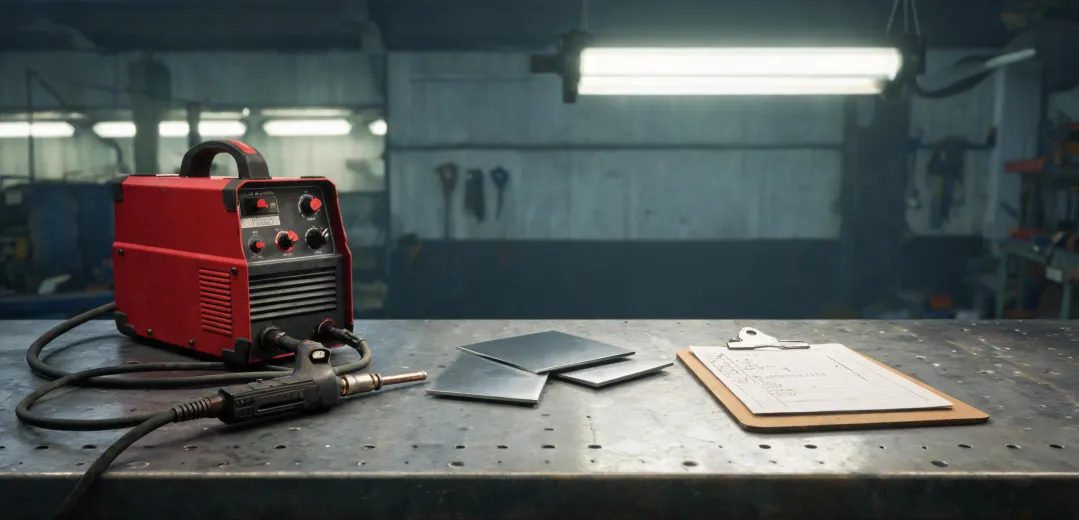
If you're reading this because you typed "buy laser welding machine" or "Hobart engine driven welders" into a search bar, I'm guessing you're at the same mental stage I was in 2017. You think the hard part is finding the machine. It isn't. (Sorry.) The hard part is what happens between the spec sheet and the first real weld a month later.
I've spent seven years working around welding equipment orders—first behind a distributor counter, then in a service shop that handled new-machine setup and repair returns. In that time, I've personally made (and documented) 11 significant mistakes, totaling roughly $28,000 in wasted budget. That number includes return freight, restocking fees, and one especially painful reorder. Now I maintain our team's pre-purchase checklist. This article is the short version of that checklist.
The problem I kept seeing
Early in that job, I thought the problem was choosing between brands and specs. A buyer would say "we need mining welding equipment" and I'd mentally go to amperage, generator size, duty cycle, warranty. I'd ask MIG vs. stick vs. TIG. I'd mention machine learning welding monitoring if the buyer sounded tech-savvy.
It's tempting to think you can compare two machines the same way you compare phone plans: same features, different price, pick one. But identical specs from different vendors can result in wildly different outcomes. That's not because one manufacturer is evil and the other is saintly. It's because a machine does not perform in isolation. It performs in a specific place, with a specific operator, on specific material, in specific weather. I didn't ask enough questions about any of that.
The deeper problem: it's not the machine, it's the system around it
When I say "problem," I do not mean a math error in the spec sheet. I mean a gap in the whole system: application, training, environment, and expectations. Let me break that down.
Vague requirements hide real applications
In 2021, a mining maintenance contractor asked for "a good all-round welder for our service trucks." When I asked what they'd be welding, the answer was "steel, whatever, you know." I recommended a shop-class unit. It was wrong. They needed a Hobart engine driven welder because their trucks were 120 miles from a power outlet and the work area changed daily. The unit we sold sat in a truck bed for three weeks before the buyer admitted it was not practical.
The return cost $780 in freight plus a 15% restocking fee. Then the machine had to be inspected, re-tested, and sold as open box. The buyer lost three weeks of productivity. I lost credibility. And none of that had to happen if we had simply asked one question upfront: "Where does this need to run, and what's between that place and the nearest power source?"
What most people don't realize is that "portable" doesn't mean "can run anywhere." A 120V inverter will do a lot, but it is not an engine driven welder. If you're in a mine haul road or a pipeline right-of-way, the power source is the decision. The brand and amperage are secondary.
The operator gap
A welding machine only produces an arc. The weld still comes from the person holding the torch. I've watched a $12,000 autoset wonder sit idle for two months because the experienced operator left and no one else knew how to set the parameters. The classic beginner mistake is to spend 90 minutes comparing output curves and zero minutes on training.
If you're buying your first welding setup, factor in education before you factor in gimmicks. The Hobart Institute of Welding Technology has been teaching this craft for decades, and there are other good programs too. I can't vouch for every "5-day get-certified" online course, but I can vouch for the value of supervised practice. The machine is the smallest part of the process.
Technology theater
There's a lot of noise around machine learning welding. Some systems monitor arc quality, track parameters, and flag defects before they become failures. That is genuinely useful. But it is a diagnostic tool, not a substitute for an operator who can see that the torch angle is off.
The same logic applies to a laser welding machine. In the right application, it can produce clean, low-heat welds and make a trained operator look like a genius. In the wrong application, it is an expensive table saw with no wood. If you search "buy laser welding machine" and the first twelve results are videos of perfect welds, remind yourself that the videos do not show maintenance, consumables, or the learning curve. (They also do not show the weld tests that failed before the perfect one.)
Be careful with marketing claims, too. Per FTC guidelines (ftc.gov), advertising claims have to be truthful, substantiated, and not misleading. So when a page implies that "anyone can weld with this machine," ask what "anyone" means. Last I checked, "anyone" has not passed a bend test.
The real cost of choosing wrong
In my first year, I made the classic specification error: I assumed "heavy duty" meant the same thing to every manufacturer. It doesn't. A customer bought a compact MIG unit on my recommendation because the duty cycle looked generous on paper. At their job site, ambient dust and high-elevation air (they were about 8,000 feet above sea level) made that duty cycle irrelevant in about 20 seconds. The machine wasn't broken; the spec just did not apply.
We refunded the machine, paid the return freight, and lost the sale anyway. When I add up that little episode: $450 restocking, $320 freight, perhaps $600 of my labor spent explaining why the machine was not actually defective. But the larger number was the lesson: a "standard" rating is not a site-specific guarantee.
Then there is the cost that never shows up on an invoice: credibility. We once recommended a $3,200 machine to a small truck repair shop. The owner trusted us. When it underperformed, he did not reorder, and he told three other local owners not to use us. That mistake cost me more than the $450 restocking fee. It cost the relationship, which is the only thing that matters in a B2B market that small.
For mining operations, the stakes are higher. If the wrong machine is the only one on a remote site, downtime is not measured by the machine's hourly rate. It's measured in haul truck waiting time, missed maintenance windows, and whatever the crew is paid to stand around. I've sat in meetings where the cost of one hour of downtime was enough to make me re-check my own invoice. Even when the number is smaller, the lost time is real.
So glad I finally started asking for photos of the actual job site. The first time I did it, a customer said "we mostly work outside." The photo showed a generator shed with a 50-amp plug, but the path from the plug to the work area was 200 feet of loose sand. That single photo changed the recommendation from a 230V inverter to an engine drive. I've used that habit ever since, and it has caught at least a dozen mistakes before they shipped.
What actually works (the short version)
I said earlier that I keep a pre-purchase checklist. It's not complicated. If you are about to spend serious money on welding equipment, do this before you open a catalog:
- Name the actual job. Material, thickness, position, how many hours of actual arcing per day. Write down the hardest weld you can remember doing, not the average one.
- Name the environment. Distance from power, altitude, dust, rain, wind. If the job is outside and far from an outlet, an engine driven welder—like a Hobart engine driven welder—is often the honest answer.
- Name the operator. Who will use it next month, and how will they learn? If the answer is "we'll figure it out," budget for training first. The Hobart Institute of Welding Technology is a solid starting point, but the point is to have a plan.
- Name the failure mode. What is most likely to break, and how long will parts take? A cheaper machine feels like a deal until a repair means four weeks of downtime.
- Ignore the hype until steps 1-4 are done. Machine learning welding analytics, laser welding attachments, and other advanced features are amazing when they solve a real bottleneck. They are expensive distractions when they don't.
I don't have a crystal ball. I do have a stack of post-mortems from my own bad calls. The small customers are the ones I feel worst about, because they often get the least support. That's backwards. When I was starting out, the vendors who treated my $200 orders seriously are the ones I still use for $20,000 orders. Small doesn't mean unimportant—it means potential.
Before you type "buy laser welding machine" or "Hobart engine driven welders" into your next search, take five minutes to write the one-page context that a product page cannot give you. The machine you choose matters. The system around it matters more.