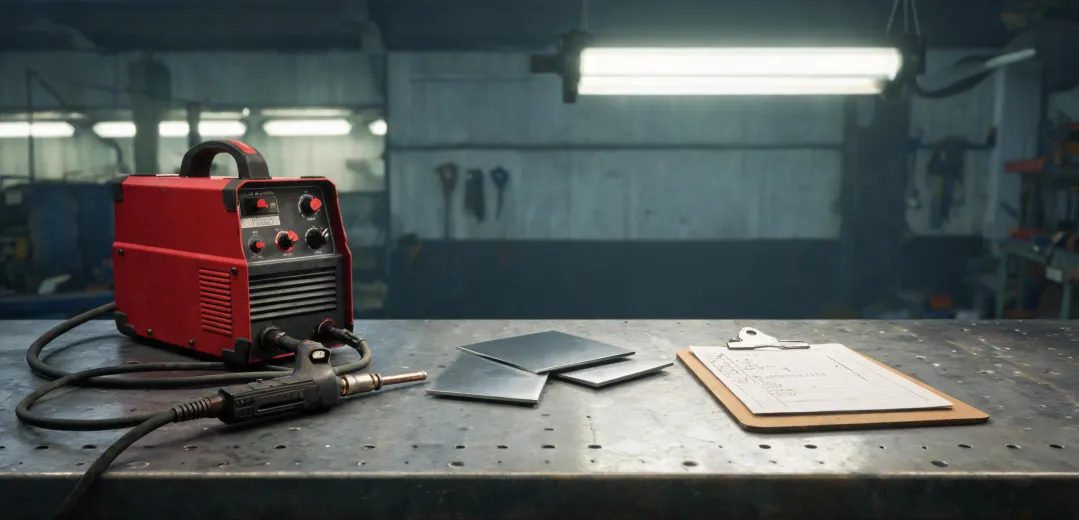
Most procurement advice about welding equipment is stuck in 2010. Here's my view, stated plainly: the mid-range welding market has matured so much that "you get what you pay for" is no longer the reliable rule it used to be. A capable 140 Hobart welder can handle a surprising range of fabrication work for a fraction of what a premium machine costs. The industry evolved. Your purchasing criteria probably didn't.
Before you tune me out, some context. I'm a procurement manager at a 40-person fabrication company. I've managed our welding equipment budget—roughly $30,000 a year, $180,000 in cumulative spend over six years—and documented every order in our cost tracking system. I've negotiated with more than a dozen suppliers. I've bought cheap machines that failed. I've bought premium machines that were overkill. I've built the spreadsheets. And I've changed my mind about what "good value" means in this market.
The Old Two-Tier Thinking Doesn't Hold Anymore
Five years ago, our policy had two categories. Budget machines for light-duty work. Premium machines for anything that mattered. The mid-range was an uncomfortable no-man's-land that nobody trusted.
That trust gap is exactly where the market changed.
In 2023, when I audited our equipment spending, I found a pattern that was hard to ignore. We'd burned $4,700 over two years on budget machines that died within months. I knew we should have tested them more thoroughly before rolling them out to the shop, but I figured, "they're for light work, what's the worst that could happen?" The worst happened when the second one died mid-job on a Friday. Had two hours to decide before the weekend shutdown. Normally I'd get multiple quotes and check reviews, but there was no time. I went with another budget replacement based on price alone. That's exactly how we ended up with a dead welder by Monday.
Meanwhile, the mid-range Hobart welders we'd bought as a cautious experiment were still running with zero major repairs. The upside was clear on paper, but the risk was reputational—what if the mid-range units didn't hold up? I kept asking myself whether saving $500 per machine was worth the gamble. The specs have genuinely shifted the odds: the Hobart Handler 140, for instance, runs on standard 120V household current, feeds wire smoothly, and handles the light-to-medium fabrication work that makes up the bulk of our jobs. Is it a Miller or a Lincoln? No. But not every job needs one.
Run the numbers yourself. Over a five-year horizon, the "cheap" machines cost us nearly double the mid-range machines once you counted replacements, repairs, and downtime. That's before you assign any dollar value to the frustration of a welder that won't feed wire right when you're on a deadline.
I'm not 100% sure the ratios hold for every shop, but the structure of the math does. Purchase price. Expected lifespan. Repair frequency. Parts cost. Labor cost of downtime. When we built our TCO spreadsheet, the gap between a $340 machine lasting 11 months and an $850 machine lasting four-plus years wasn't close.
The Specialty Segment Evolved Too
It's not just the mid-range MIG machines. The whole equipment landscape looks different than it did a decade ago.
Take orbit welding machines. Ten years ago, orbital welding meant five-figure price tags and pharmaceutical or semiconductor contractors. Now, there are accessible orbit welding machine options that make sense for smaller shops doing stainless tubing work. The argument is compelling: consistent penetration, fewer rejected welds, documented weld data for clients who require it. The capital cost is real, but so is the savings on rework.
Then there's the confusion around PPR welding machines. If you've ever searched "PPR welding machine wikipedia" because you assumed it was some kind of arc welder, you're not alone. Here's the thing: a PPR welding machine is for polypropylene pipe fusion. It's a plastic-piping tool, not a metal welder at all. I've seen companies order the wrong equipment because someone skimmed a search result. We were using the same word but meaning different things. Discovered this when the invoice arrived and it clearly wasn't what the shop needed.
The niche brands are worth a look too. Eagle welder machines—Eagle Arc's inverter units, specifically—are a legitimate cost-conscious option for hobbyists and light commercial work. They're not Hobart, and they don't claim to be. But the quality level in that corner of the market is unrecognizable compared to fifteen years ago. The point isn't that every brand is equal. The point is that the market now has viable options across every price band, and the old two-tier assumption misses the entire middle.
What Still Hasn't Changed
I don't want to overstate the case. Some fundamentals are non-negotiable, and anyone who tells you otherwise is selling something.
Safety standards still matter. ANSI Z49.1 still defines safe welding practices, and OSHA's 29 CFR 1910.252 still governs welding, cutting, and brazing in the workplace. If a machine doesn't meet basic safety requirements, no price justifies it. Period.
Local support still matters. When I bought our first Hobart Handler 140, I made sure the local welding supply shop could service it and stock parts. That decision paid off twice: once when we needed a liner replacement on short notice, and again when their technician talked me out of a needless repair. The relationship itself had value.
Honest capacity ratings still matter. A 140-amp input machine is not going to weld 1/2-inch plate all day. It won't. Specs improved, but physics didn't.
The Objection I Know You're Raising
I get the skepticism. "Hobart is the budget brand at the welding supply store." I thought that too, once. But here's the thing: this is the same company that built a reputation on commercial kitchen equipment—restaurant dishwashers, mixers, and grinders that run for decades under brutal conditions. That engineering DNA carries into Hobart welders. And while the Handler 140 is a 120V machine that looks hobbyist at first glance, the difference shows up in the construction, the wire feed consistency, and the service network behind it.
Granted, buying mid-range requires more analysis than defaulting to the most expensive brand. You have to be honest about your duty cycle and your actual needs. That's work. But it's the kind of work that pays for itself.
One of my genuine regrets: not doing this analysis sooner. I still kick myself when I think about the budget machines we bought in 2022 and 2023. If I'd built the TCO spreadsheet three years earlier, we'd have saved thousands. The "cheap option" wasn't cheap. It was just cheaply priced.
What I'd Recommend in 2025
If you're responsible for buying welding equipment this year, here's where I'd start:
- Write down your actual duty cycle. Be honest about how many hours per week the machine will run and what thickness material you're welding. This eliminates 80% of the guesswork.
- Calculate five-year TCO, not purchase price. Include downtime, repairs, and rework in your model. This changes the conversation fast.
- Test the mid-range before you dismiss it. We did, reluctantly. The Hobart welders proved themselves within six months.
- Know the specialty options. Orbital welding machines for stainless tubing. PPR fusion machines for plastic pipe. Eagle Arc for cost-sensitive roles. Buy the right tool for the actual job.
- Keep a local supplier relationship. The internet is great for prices. It's terrible for emergency parts and hands-on advice.
There's something satisfying about watching the cost-tracking spreadsheet at year-end and seeing welding equipment spend down 17% while the machines run better than before. After the stress of those budget-machine failures in 2023, finally having a rational equipment plan is a payoff I feel every week.
The welding equipment industry evolved. The old rule needs a new version: you still get what you pay for, but what counts as "enough" has moved dramatically in your favor. The fundamentals—safety, support, honest spec evaluation—haven't changed. The execution has transformed. Update your criteria, run the numbers, and buy accordingly.
Your budget will thank you.