-
The Machine Isn't the Expensive Part
-
Reason 1: Where You Buy Beats What You Buy
-
Reason 2: A GMAW MIG Welder and a Heavy Welding Machine Are Two Different Decisions
-
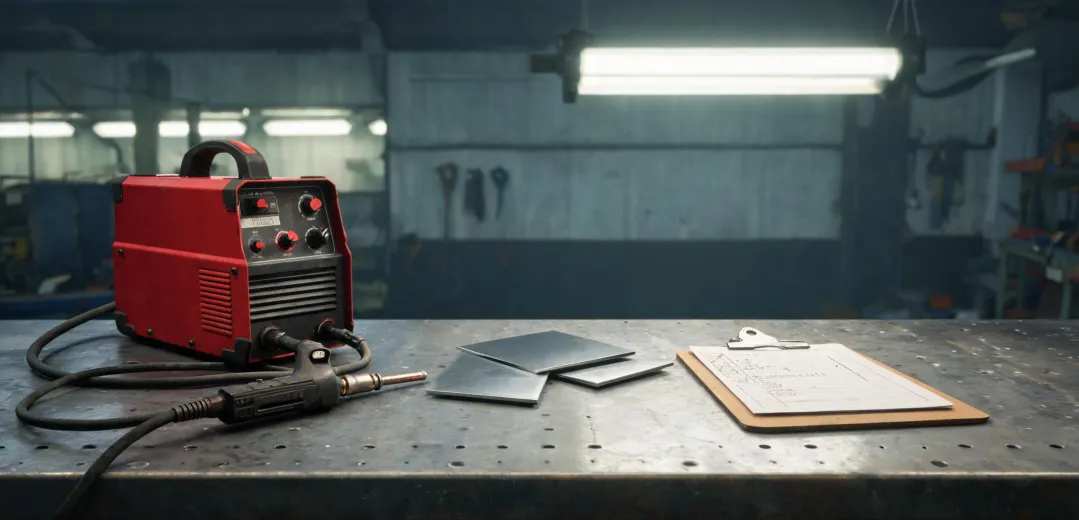
Reason 3 (The Counterintuitive One): The Welding Machine Image Tells You More Than the Spec Sheet
-
“But Specs Matter, Right?”
-
What I'd Actually Tell Someone Starting Out
-
The Re-Statement
The Machine Isn't the Expensive Part
Here's my take after seven years buying welding equipment for a small fab shop: the most expensive mistake isn't picking the wrong machine. It's picking the right machine from a place that can't keep you running when something breaks on a Tuesday afternoon.
I wish I'd learned that in a classroom instead of in a lawyer's office, but here we are.
March 2019. We had a railing job — about 400 joints, mostly mild steel, nothing exotic. I saved $900 on a heavy welding machine from a regional dealer I'd never used before. Three months in, the wire drive assembly failed. They didn't stock it. The manufacturer said four to six weeks. We paid $3,200 in penalty clauses on that railing job, plus $400 to rent a backup machine on 24 hours' notice. Call it $4,200 out of pocket on a decision that was structured to save me $900.
That's the day I stopped evaluating welding machines like products and started evaluating them like service systems.
Reason 1: Where You Buy Beats What You Buy
When someone searches for a Hobart 225 welder at Tractor Supply, I actually think that's the right instinct — even if they're not sure why yet. National retail channels matter in this trade. Not because the machines on the shelf are magic, but because the parts return path is predictable and fast.
Here's the thing most buyers miss. Hobart welding parts — contact tips, nozzles, liners, drive rolls, gun assemblies, trigger assemblies — are mostly standardized within a product family. Once you know your model number, ordering parts is straightforward. The catch is that if you bought from a channel that doesn't stock those parts, you're the one calling around on a Wednesday morning trying to locate a $12 consumable so a job that's already late can move forward.
Half of my weekly supply runs used to be that exact call. Not anymore.
Early rookie mistake, and I'll own it here because it cost me real money: in my first year I assumed a contact tip for one torch was interchangeable with a tip from a different torch because the threads looked close. It wasn't, and they weren't. I bought 25 of them for about $280. Every single one was wrong for the machine I was actually running that week. That's six days of waiting I'll never get back.
Reason 2: A GMAW MIG Welder and a Heavy Welding Machine Are Two Different Decisions
I see people lumping a GMAW MIG welder and a heavy welding machine into the same sentence all the time. They're not in the same category. They don't compete. Most of the time they don't even share a consumable ecosystem.
A GMAW MIG welder in the 210–250 amp range — the kind of Hobart Handler people usually look at first — is happiest on 1/4" plate or thinner with a normal duty cycle. Set up right, it lays down a beautiful bead. It is not built to run eight hours a day on 3/8" stock. If you push it there, you find out pretty fast where the thermal cutout lives. That's an expensive way to learn the difference between “rated” and “made for it.”
A heavy welding machine — the kind you buy for structural work, thick plate, or all-day production — competes on totally different dimensions. Duty cycle at specific amperage. Drive system durability over thousands of hours. Real parts availability. How close the nearest service center is if something electronic lets go.
When someone asks me which to buy, I ask them one question first: is your heaviest weld your ceiling, or is it your average? If it's a ceiling you hit a few times a week, buy MIG. If it's what you run every single day, go heavier. That one question has kept me out of three bad buys since 2020.
Reason 3 (The Counterintuitive One): The Welding Machine Image Tells You More Than the Spec Sheet
This sounds weird coming from someone who just spent two sections talking about specs, but here it is anyway: a real welding machine image tells you more about whether you'll actually love a machine than any spec table will.
Actual photographs — not marketing renders — show you where the controls sit, where the spool goes, which direction the gun connector faces, and how bad the wire feed tensioner access really is. Those little details cost minutes on every weld. Over a year, that's hours. Over the life of a machine, that's the difference between a tool you reach for and a tool you avoid.
I returned two machines in four years because the stock photos were hiding the real geometry. Consumer-grade photos show real proportions. Manufacturer renders show you the version they wish they'd designed. That gap is where purchase regret lives.
“But Specs Matter, Right?”
Yes, and I'm not arguing they don't. Duty cycle at a given amperage. Input voltage. Wire capacity. Spool size. Those are all real numbers and they matter at the margin.
But here's what I'd say back. If I put a machine with slightly better specs from a supplier whose parts catalog I can't find next to a machine with slightly weaker specs from a supplier I've ordered from every month for two years, and I have to depend on one of them for a paying job, I know which one I'm buying. It isn't close.
The spec sheet is what the machine is supposed to be on day one. The parts network is what it actually is on day 400, when it's mid-job and you're trying to make payroll.
And honestly, the day-400 version is the only version that shows up in your profit and loss anyway.
What I'd Actually Tell Someone Starting Out
Buy from a channel that will still be around in six months and already stocks consumables for the thing you just bought. That might be a national retailer. It might be a regional industrial distributor. It might be a local welding shop that knows your name. It is not a drop-shipper on a random marketplace, and it is not a deal from someone who is inventing delivery dates as they go.
Then pull up the parts diagram for the model before you pull up the amperage rating. If you can't find the diagram, that's your answer. If you can find it but the parts are six weeks out, that's also your answer.
The Re-Statement
Buy the ecosystem, not the machine. Everything else — the color, the marketing, whichever model your buddy happens to swear by — is secondary. Parts availability, service response speed, and a dealer relationship you actually trust are what keep you welding when a job is on the line.
A spec sheet won't do that. A parts counter that answers the phone will.
I keep a checklist now — twenty-two items, born out of that 2019 lesson and a handful of others I'd rather not re-litigate. The first item isn't price or amperage. It's “where does the contact tip come from.” Item two is “how fast can I get a new one to the shop.” Because in this trade, once you've had one bad month of downtime, you learn where the real money goes. It goes to whoever had the spare part on the shelf.