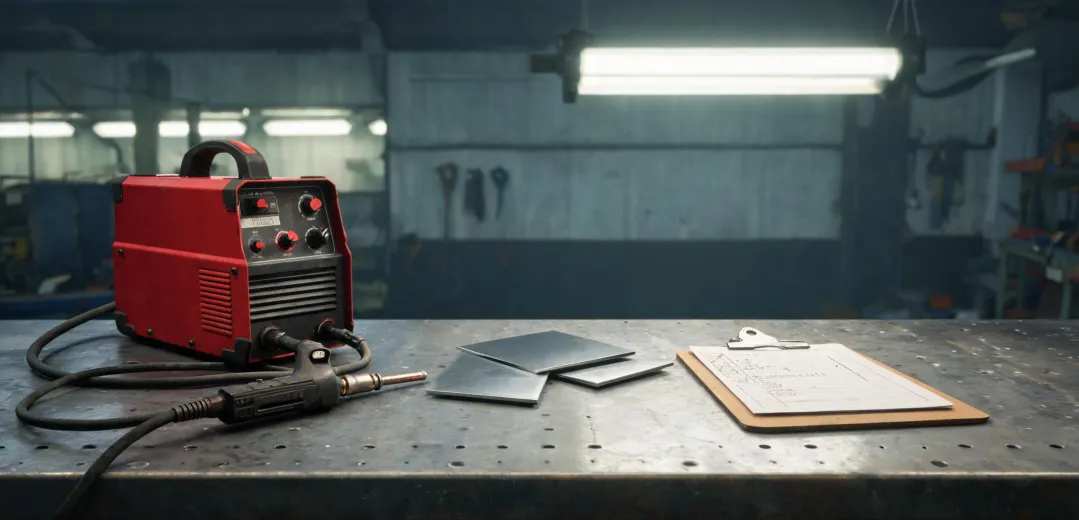
November 2023. Our maintenance shop's old MIG welder finally quit — the repair quote came back higher than a replacement, so it wasn't really a decision anymore.
I'm a procurement manager at a 140-person metal fabrication company in Ohio. I've managed our equipment budget (roughly $310,000 annually) for 9 years, negotiated with 60+ vendors, and logged every order in our cost tracking system. So when our shop foreman told me to "just grab something that works," I didn't just grab something.
I ran it through our standard process: three quotes.
The first came from a local distributor: a Hobart Handler 160 — the portable MIG welder everyone in our shop had used at some point. 160 amps, spool-gun capable, about 20 kg. Quote: $720, shipping included.
The second quote was for a Hobart Handler 260 — the bigger brother. 260 amps, better duty cycle, thicker material capacity. Quote: $1,250.
The third came from a trading company: an MMA welder inverter — portable, light, $395.
$395 versus $720. That gap sat in my inbox for two days.
I went with the cheap one.
What the spreadsheet didn't show
For the first two months, it was fine. Genuinely. The inverter welded. Our shop guy patched a few racks and shrugged like, "See? Told you."
Then month three.
We took on a batch of stainless fixtures — nothing exotic, but continuous welding with tight quality specs. The cheap machine started overheating twenty minutes in. Its duty cycle just couldn't hold. Our welder would get maybe ten seconds of arc, then wait. He wasn't happy. "This thing is slower than my hand."
Four days on a job that should've taken two. The delta — overtime, a pushed deadline, one client email I'd rather forget — came out to roughly $1,400.
Then consumables. The inverter was picky about wire. We cycled through three suppliers. One batch of welds failed QC. Rework: about $450.
Then we had to rent. A rush job came in for wire mesh welding machine meshweld components — parts the cheap unit had no business touching. We rented a proper industrial rig for three days. $380.
The TCO spreadsheet I wish I'd built first
In January 2024 I sat down and rebuilt the numbers. Here's what that $395 actually cost us:
- Unit: $395
- Deadline overrun (labor + rush fees): ~$1,400
- Rework on failed welds: ~$450
- Rental coverage: $380
- Consumable trial-and-error: ~$320
- My time + foreman's time on coordination (12 hrs @ ~$50/hr internal): ~$600
Total: roughly $3,545.
The Hobart 160 we didn't buy? $720, freight included, with local dealer warranty and a consumables supply chain we already use for our other Hobart machines.
I stared at that number for a while.
Where the comparison actually got interesting
Later I pulled the spec sheets side by side — the cheap inverter vs. the Hobart 160 and 260.
On paper? The no-name inverter looked competitive. Inverter tech, low weight, folding handle. Nothing in the datasheet screamed "slow down, this'll bite you."
But datasheets don't show you the stuff that matters on a shop floor:
- Consumable compatibility (ours hated brand-A wire, loved brand-B, ignored brand-C)
- Duty cycle behavior in real summer heat (the specs are generous, honestly)
- Parts availability when something breaks ("four to six weeks from overseas" — no thanks)
- Whether your welders actually trust the arc, or fight it all day
Hobart's been building welding gear for decades. Their portable welder MIG and MMA welder inverter lines are backed by a real parts network, a genuine training arm (they run the Hobart Welding Institute), and a resale value that means you're never fully stuck with a lemon.
That didn't show up in the quote. It shows up in year two.
It took me 9 years and probably 200+ equipment purchases to understand something I'd read a hundred times: the lowest quote is almost never the lowest cost. You have to live through one of these to actually believe it.
What we ended up doing
February 2024. We sold the cheap unit at a loss (it's fine, let's move on). Then we bought:
- A Hobart Handler 160 for day-to-day shop repair and portable work — $720
- A Hobart Handler 260 for the heavier jobs, including the meshweld-adjacent work we'd been renting for — $1,250
Total: $1,970. About $1,575 more than my original "smart" choice.
Three months later, the 260 landed us a thick-wall pipe job we would've turned down before. That one job billed out at over $4,000.
Would I call that a clean ROI story? Not exactly. I don't have hard data on how much the cheap unit would've cost us over a full year — I only have the 4 months of pain I can actually document. What I can say is that the delta was recovered inside a quarter, and nobody's booking rental welders anymore.
A few things I'd tell anyone running the same math
I'm not a welding metallurgist — I can't speak to arc characteristics or wire chemistry. That's not my lane. What I can speak to is procurement math. Three things:
- Price the downtime. Every hour your equipment is down is an hour of labor you're paying for anyway, plus the client relationship you're damaging. That number is usually bigger than you think.
- Price the consumables. Cheap machines often fight brand-name wire. Compatible consumables cost more per unit, but they don't cost you rework.
- Price your own time. Coordination, sourcing, emergency rentals — I figure our internal time at about $50/hour. Add it. It changes the decision.
Brand matters, but not in the way most procurement folks mean it. It's not about the logo. It's about the ecosystem behind the machine: parts availability, service response, training, resale. That is total cost of ownership.
Now whenever someone asks me "which one is cheaper," I ask them three questions back: How long are you keeping it? What are you actually welding? And when it breaks on a Friday afternoon, who fixes it?
The answer rarely comes down to the sticker price.