-
Who this checklist is for
-
Step 1: Define the actual job before you name a brand
-
Step 2: Verify electrical and battery compatibility
-
Step 3: For food equipment, check sanitation and blade specs
-
Step 4: For welders, check input power, duty cycle, and consumables
-
Step 5: For positioners, match load, rotation, and safety
-
Step 6: For imported wear parts, calculate landed cost and quality
-
Step 7: Lock down after-sales and return terms
-
Common mistakes and final checks
I have been handling commercial equipment and welding supply purchase orders for 8 years. I have personally made and documented 11 significant mistakes, totaling roughly $15,950 in wasted budget. Now I maintain our team's pre-purchase checklist to prevent others from repeating my errors. This checklist is for B2B buyers who are about to approve a Hobart meat slicer, a Shindaiwa welding machine, a welding positioner machine, welding helmet batteries, or imported wear parts.
It has 7 steps. It is not a negotiation script. It is the blocking-and-tackling list I wish I had used before I learned some lessons the expensive way.
Who this checklist is for
Use this when you are buying standard commercial kitchen or welding equipment and you have enough lead time to verify specs. If you are in an emergency breakdown and need a part tomorrow, this list is probably too slow. In that case, call your service tech first and use the list for the replacement order. I recommend this for planned purchases, but if you are dealing with a one-off custom fabrication line, you may need an engineer's review before you use any checklist.
Step 1: Define the actual job before you name a brand
Write down the job in one sentence. For a meat slicer Hobart purchase, that sentence is not 'buy a Hobart slicer.' It is 'slice 40 lb of cooked beef per day at 3/16 inch thickness for 4 hours without overheating.' For a Shindaiwa welding machine, it is not 'buy a welder.' It is 'run 1/8 inch 7018 stick electrodes on 3/8 inch carbon steel for 6 hours a day.'
That sentence will tell you the voltage, duty cycle, blade size, and load capacity you need. It also gives you a way to say no. In my opinion, most bad purchases start because the spec was a brand name instead of a job.
Step 2: Verify electrical and battery compatibility
This is where I lost my first $2,950. In March 2022, I approved a meat slicer Hobart order with the wrong voltage. Three units arrived 208V. Our kitchen was 115V. The return freight and delay cost $1,850. Then in 2021, I ordered 24 replacement batteries for a Hobart welding helmet without checking the model number. The Hobart welding helmet battery was the wrong size and connector type. That was $1,100 straight to the trash.
Now I check three things before approval: input voltage (think 115V vs. 208V, or single-phase vs. three-phase), plug type, and battery model or charging base. For welding helmets, take a photo of the label inside the helmet. Do not trust a listing photo. For food equipment, confirm the nameplate voltage and whether the unit is hardwired or cord-and-plug.
Step 3: For food equipment, check sanitation and blade specs
For a meat slicer Hobart or any powered food prep equipment, the spec sheet is not enough. Check for an NSF/ANSI 8 listing. That standard covers commercial powered food preparation equipment. If the listing is missing, you are taking a sanitation risk that your inspector may not accept. Also verify blade diameter, carriage travel, and whether the blade is replaceable with a commonly stocked part.
I learned this after buying a slicer with a non-standard blade guard. It worked fine for 5 months. Then we needed a replacement guard and waited 7 weeks. The machine was down, and we paid overtime to use a manual slicer. The part cost less than $120. The downtime cost more than $2,000.
Step 4: For welders, check input power, duty cycle, and consumables
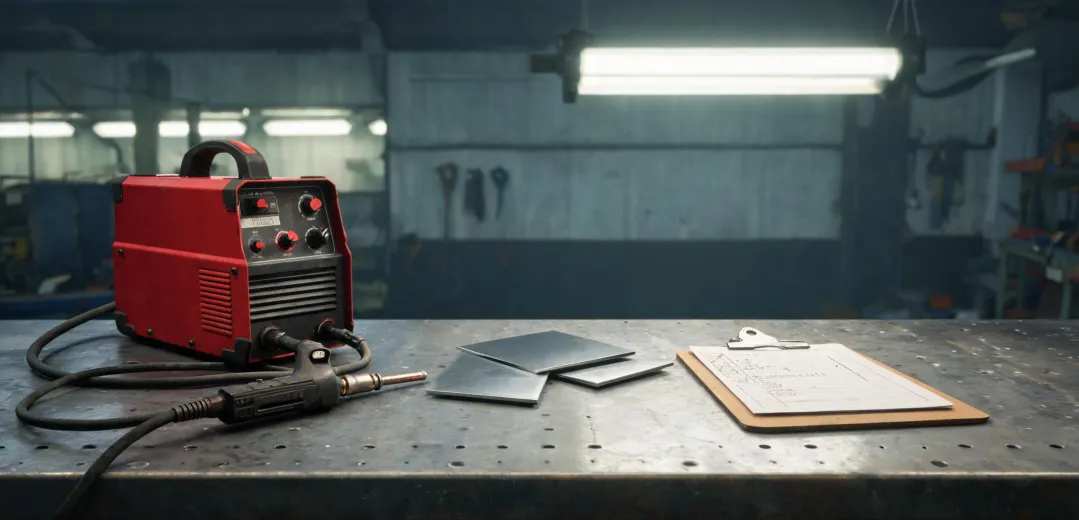
A Shindaiwa welding machine can look perfect on paper and still be wrong for your shop. Check input power first. Can your panel support it? Then check the duty cycle at the amperage you actually run. A 60% duty cycle at 200A is not the same as 60% at 300A. If you are running production, a machine that shuts down every 6 minutes is not a bargain.
I once approved a Shindaiwa welding machine based on a 10-minute demo. It was likely fine for light repair. It was not fine for our 40-hour production week. The machine went into thermal shutdown twice on day two. We returned it and paid a 15% restocking fee. That was a $3,800 mistake. Everyone told me to verify duty cycle before approving. I only believed it after that week.
Also check consumables. Torch tips, liners, drive rolls, and stick electrode holders should be easy to source. OSHA 29 CFR 1910.252 is the baseline for welding safety, and ANSI Z87.1 covers eye and face protection. Verify that the supplier provides the correct safety documentation with the unit.
Step 5: For positioners, match load, rotation, and safety
A welding positioner machine is not just a rotating table. The load rating must include the workpiece, fixture, and any offset. If you exceed the rated capacity at the edge of the table, the head can slip or fail. We underestimated a welding positioner machine load by 300 lb in Q3 2023. The head slipped during a tack weld. The repair and downtime cost $4,200.
Check three numbers: axial load, radial load, and rotation torque. Then check the safety stops and grounding. A positioner that cannot be locked out safely is a hazard. If your parts are long or off-center, ask the supplier for a turning moment calculation. If they cannot provide one, that is a red flag.
Step 6: For imported wear parts, calculate landed cost and quality
When you are comparing a China welding wear sinter machine part price, the unit price is only the beginning. Add freight, duty, customs clearance, and your time. Check the HTSUS classification and current duty rates at U.S. Customs and Border Protection (cbp.gov). Do not trust a landed-cost estimate from a sales email alone.
As of January 2025, I was seeing China welding wear sinter machine part price quotes from about $12 to $85 per piece depending on size, hardness, and quantity. Verify current pricing and specs directly. I once chose a quote that was 40% lower than our domestic source. The part failed in 3 weeks. The downtime cost $5,000. It took me about 4 years and 200 purchase orders to understand that the cheapest line item is often the most expensive decision.
Step 7: Lock down after-sales and return terms
Before you sign, confirm who services the unit, how long parts take, and what the return window is. For a Hobart meat slicer, ask about local service and blade availability. For a Shindaiwa welding machine, ask about board-level repair or replacement. For a welding positioner machine, ask about load testing and installation support. For imported parts, ask for material certificates and a sample before a full order.
Even after choosing the new Shindaiwa welding machine supplier, I kept second-guessing. What if the duty cycle wasn't as advertised? I did not relax until the first 40-hour production week finished without thermal shutdown. That is normal. A good return policy and a clear service path make that doubt manageable.
Common mistakes and final checks
Do not approve from a quote alone. Do not assume a brand name covers every model. Do not ignore voltage, battery, or load ratings. Do not let a low China welding wear sinter machine part price hide freight and failure costs. And do not skip the pre-check because the buyer says it is urgent. Urgency is usually what caused the mistake.
This checklist works for most standard B2B equipment orders. It is not a substitute for an engineer's review on custom machinery or a licensed electrician's sign-off on high-voltage installations. If your situation is outside the standard path, say so early and bring in the right specialist. In my experience, honest limitations up front are cheaper than a redo.
Prices and time references are from my own quotes and records, mainly 2021 to 2025. Verify current specs, rates, and regulations with the manufacturer, your electrician, and official sources before purchase.