-
The Vendor Who Says "We Don't Do That" Is Worth More Than the One Who Says "Sure"
-
The $3,800 Lesson From a "Do-Everything" Welder
-
Why Hobart Keeps Coming Up in My Searches—And What That Tells You
-
Your Own Search Behavior Proves This Point
-
"But I Just Want Convenience" — Addressing the Pushback
-
My Procurement Rule (And Where It Doesn't Apply)
The Vendor Who Says "We Don't Do That" Is Worth More Than the One Who Says "Sure"
I've been handling equipment procurement for nine years. I've personally made—and documented—eleven significant purchasing mistakes, totaling roughly $14,000 in wasted budget. Now I maintain our team's checklist to prevent others from repeating my errors.
Here's the first item on that checklist: does this vendor know what they're not good at?
I know that sounds backward. We're trained to want vendors who say yes to everything. Who offer the most products, the widest range, the "one-stop solution." But after nine years and fourteen grand in mistakes, I can tell you the opposite is true: the vendors who acknowledge their boundaries are the ones who actually deliver.
The $3,800 Lesson From a "Do-Everything" Welder
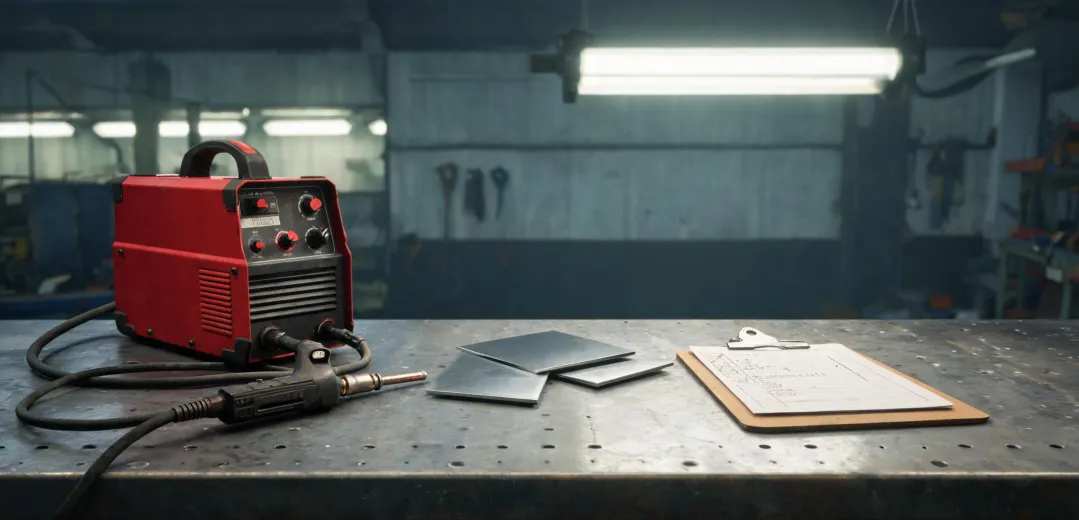
In March 2019, I bought what a sales rep pitched as the "best multiprocess welding machine" on the market. MIG, TIG, stick, plasma cutting—all in one unit. The pitch was airtight: one machine, every application, half the cost of buying separate units.
Six months later, I was eating the cost. The aluminum welds were inconsistent, the thin-gauge work warped, and the plasma cutting had a duty cycle so short it was barely usable in production. We had to redo a batch of 34 stainless steel brackets. When I added up the rework, wasted material, and two days of downtime, the total came to $3,800.
What I learned wasn't that multiprocess welders are bad. It's that a machine designed for everything is rarely optimized for anything. The sales rep never once said "this isn't ideal for thin aluminum." He never mentioned the duty cycle limits. He just said yes to every question I asked.
I should've known better. I've been burned by "one-size-fits-all" promises before—just usually with smaller price tags.
"Per FTC advertising guidelines (ftc.gov), performance claims require substantiation. Before accepting a vendor's claim that their product 'handles everything,' ask what evidence backs that up."
Why Hobart Keeps Coming Up in My Searches—And What That Tells You
If you've ever typed "Hobart" into a search bar, you know it's a confusing word. Some people are looking at a hobart commercial stand mixer for their restaurant. Others want a welder machine tig for their fabrication shop. And then there's a third group searching for houses for sale hobart indiana—completely different need, same keyword.
That word has range. But here's what's interesting: the businesses that use that name successfully don't try to be everything to everyone. They pick a lane.
We run a Hobart commercial stand mixer in our prep area. It's been running eight years with nothing but routine maintenance. No digital controls, no multi-function attachments, no "smart" anything. It mixes. That's it. And it has never let us down.
That single-purpose design is exactly why it works. Compare that to equipment that tries to grind, slice, mix, and blend—and ends up mediocre at all four.
Same logic applies in welding. Take an exothermic welding machine—used for electrical grounding connections. You don't need a "versatile" machine that also does exothermic work. You need something designed for that exact application, operated by someone who understands the process. Trying to stretch one tool across incompatible jobs leads to exactly the kind of $3,800 mistake I made.
Your Own Search Behavior Proves This Point
Think about how you got here. You searched for something specific—"best multiprocess welding machine" or "hobart commercial stand mixer." Not just "equipment." You knew what you needed.
Search engines understand this. When someone types "Hobart," the algorithm handles commercial mixers, welding equipment, and Indiana real estate as separate categories. It doesn't pretend those are related just because they share a word.
If search algorithms need category boundaries to stay useful, imagine how much confusion a vendor creates by claiming to do it all.
"But I Just Want Convenience" — Addressing the Pushback
I hear this one a lot: "One vendor for everything is simpler. One relationship, one invoice, one support line."
That convenience is real. But it has a cost—and it's rarely listed on the quote. It shows up when a critical piece of equipment fails and no one on the vendor's team actually specializes in that product line. It shows up when the "all-purpose" solution can't handle a job you assumed it could.
The math isn't complicated. You save an hour of vendor management and spend a week dealing with rework.
When a vendor tells you "that's not our specialty—here's who does it better," don't walk away. That honesty is worth more than a discount.
My Procurement Rule (And Where It Doesn't Apply)
Let me be clear about my context: I manage equipment purchasing for mid-sized commercial kitchens and metal fabrication shops. Not large-scale manufacturing lines, not certified welding inspection. If you're in those spaces, you need someone with deeper expertise than mine.
I also recognize these experiences are from 2019 through 2024. Pricing, models, and technology shift fast. The $3,800 figure is a historical record, not a current budget estimate.
But one principle hasn't changed: specialized boundaries beat universal promises. A vendor who can honestly say "we're great at X, and here's who's better at Y" is a vendor worth keeping.
Next time someone says "we can handle anything," try asking what they're not good at. Listen carefully to the answer.
That question will tell you more than any spec sheet ever could.