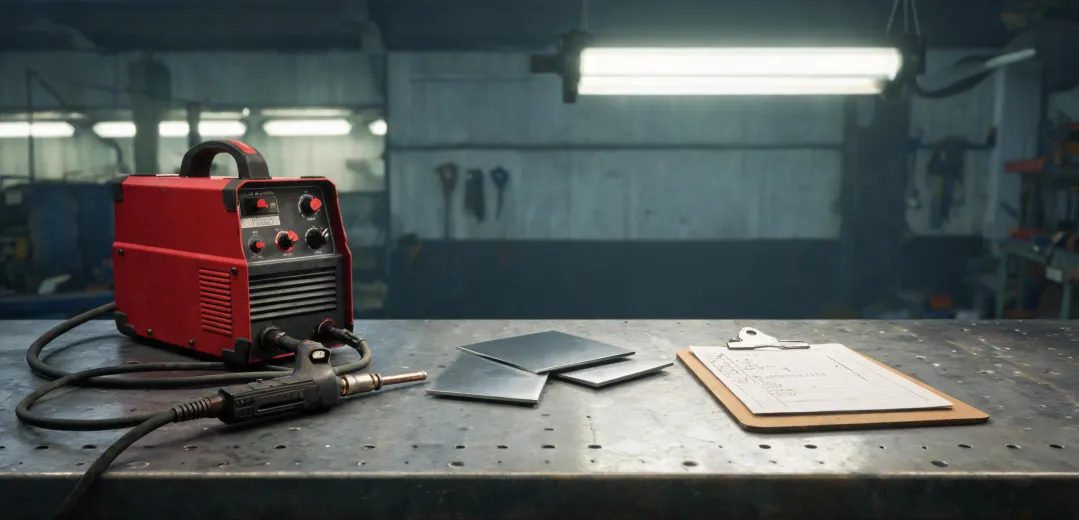
Back in March of 2024, my company moved into a bigger facility. There's no such thing as a simple move, but this one came with a twist: the building had room for a proper staff kitchen and a small fabrication bay for our maintenance team. That meant I suddenly had to buy equipment I'd never purchased in my life.
I manage purchasing for a 150-person company across three locations—roughly $300,000 a year in orders spanning 40-50 vendors. Normally I'm buying office chairs and printer toner. But this project called for a Hobart commercial dishwasher. A meat slicer. Welding equipment.
In the end, the equipment worked out. But that had more to do with a few last-minute questions than any experience on my part. Here's what happened.
Why the Kitchen Manager Wouldn't Let Me Buy Anything But Hobart
The kitchen manager—she's been running commercial kitchens for close to twenty years—handed me her list and circled one word three times: Hobart. When I asked why not a cheaper option, she said something I still repeat:
"A cheap dishwasher doesn't break during dinner service. It breaks right before it. And the repair guy doesn't care that you saved money."
To be fair, the budget dishwasher might have worked fine in a lighter operation. Maybe. But 'might' isn't a specification. I went back and forth between the Hobart and a budget brand for nearly two weeks. The budget unit was about $2,200 cheaper. On paper, the specs looked close. But when I put the two spec sheets side by side, I finally understood why she was so insistent.
The budget dishwasher needed 30 inches of clearance on every side for service access. The Hobart needed 6 inches on the sides and 12 inches in the back. The budget unit's heating element was rated for roughly half the lifetime of the Hobart's. And when I called their support line, the parts lead time for a heating element was 3 to 5 weeks. Not ideal.
Then came the close call. I'm not an electrician, and I'll be the first to admit it. When I saw "240V" on the spec sheet, I almost moved on. But I asked the electrical contractor to confirm what was actually coming into our panel. His answer: 208V, three-phase.
That matters because commercial dishwashers—and most commercial kitchen equipment, honestly—come in different voltage configurations. The Hobart AM-14 we ordered could be set up as 208V or 240V. The budget model only came in 240V, and converting it wasn't just a plug change. It meant a conversion kit, about $400, plus a week or more for the part to arrive. A week we didn't have. The moving date was locked in by the GM, announced to the entire company, and absolutely not flexible.
Commercial dishwashers also need to meet NSF/ANSI Standard 3 for sanitization—the final rinse has to hold a specific temperature to actually clean the dishes. The budget unit claimed NSF approval, but when I looked it up on the certification database, I couldn't match the model number. Maybe it was a paperwork thing. Maybe not. Either way, it didn't inspire confidence.
That's when I learned my rule: five minutes of verification beats five days of correction.
The Hobart 2912 Meat Slicer: The Easy Part
The Hobart 2912 meat slicer was the easiest decision on the list. The kitchen manager had used one at her previous job and called it "the last slicer you'll ever need to buy." For once, she didn't have to convince me. But reading the manual taught me a few things worth knowing if you're shopping for one:
- The 2912 has a 12-inch blade, which handles large cuts comfortably. The 10-inch models are fine for light prep, but for feeding 150 people a day, the 12-inch blade is the right call.
- The manual version is significantly cheaper than the automatic. For our volume, manual was fine—and it's actually faster to clean without the motor assembly.
- It disassembles tool-free, which matters more than I expected. If a slicer is annoying to clean, it doesn't get cleaned properly. In a commercial kitchen, that's a health code risk.
Also, I measured the counter before ordering. The 2912 is about 29 inches deep, and the counter we'd planned for it was 30 inches deep. That would've left a one-inch overhang. It would've worked, technically, but every cleaning cycle would've been a fight. We swapped it to a different counter before anything arrived.
The Welding Gear: Stepping Way Outside My Lane
The kitchen stuff I could learn. The welding list was a different planet. The maintenance lead—a guy named Dan who can fabricate almost anything—gave me this list:
- A rolling welding machine (a portable MIG unit on wheels)
- A welding fixture machine (a workholding table for positioning pieces)
- An ACE welder MIG 140T
I know enough to know what I don't know. I'm not a welder, so I can't speak to puddle control or shielding gas mixtures. What I can tell you from a purchasing perspective is how Dan walked me through the difference between a welder that looks right and a welder that is right.
I found a generic 140-amp MIG welder for about half the price of the ACE MIG 140T. Looked fine to me. Then Dan pointed at the duty cycle on the spec sheet. Welding duty cycle is defined by the American Welding Society as the number of minutes out of a 10-minute window a machine can run continuously before overheating. I won't recite the whole spec sheet, but the shape of it was: the generic unit was rated around 20% duty cycle at 90 amps, and the ACE was rated around 60% at 140 amps.
In plain English, the cheap welder would shut itself off on anything thicker than sheet metal. In a shop, that's not a minor inconvenience. That's people standing around waiting for a machine to cool down. If you ask me, that alone was worth the price difference.
Then we checked the consumables. Actually, I should say, Dan checked. I just listened. The ACE uses standard tips and liners that any local welding supply shop carries. The generic brand's parts had to be ordered from overseas. And the rolling cart? Not included. I'd assumed a "rolling welding machine" came with the cart. It did not. That one assumption would have cost us an extra $200 and a two-week wait.
The welding fixture machine was the purchase I questioned the most. Couldn't Dan just use clamps and a workbench? He explained it like this: "You can eat soup with a spoon. But if you're eating soup every day, you buy a bowl. The fixture table gives us repeatability." It lets them build one bracket, then build ten more identical ones without re-measuring. That's not luxury. That's math.
It also took the longest to arrive—three weeks, which was the longest lead time on the whole list. We ordered it first and it still landed a week after move-in. Annoying, but worth it. Several months in, Dan says it's already paid for itself by keeping three repair jobs in-house that would've been outsourced at $600 to $1,500 each.
The Part That Made Me a Believer
Here's the thing, though. I still wondered if we'd overspent. Then I talked to a colleague at a sister company who had bought the budget-tier dishwasher we'd skipped. He didn't say it broke. He said it "became a problem."
The heating element failed in month seven. The replacement took four weeks to arrive. His kitchen ran on a temporary dishwashing service for most of that month. The bill for that service: around $5,800. He saved about $2,200 on the purchase—and paid it back two and a half times over.
Everyone had warned me. The kitchen manager warned me. Three equipment dealers warned me. I only truly believed them after I saw that alternative play out.
What I'd Tell Anyone Outfitting a Facility
Look, I'm not saying budget equipment is always the wrong choice. Budgets are real, and sometimes cheap is the right call. What I am saying is that verification beats discount hunting, every single time.
The checklist I now use for any equipment purchase:
- What voltage does your building actually have? Confirm it, don't assume. Dishwashers, welders, and mixers all come in different configurations.
- Does it physically fit? Measure the equipment, the doorways it has to pass through, and the service clearance in the manual.
- How long does a part replacement take? Call support and ask. If nobody local can service it, treat that as a real cost.
- What's the duty cycle or continuous-running rating? Can it survive your actual usage level?
- What's included in the box? Cart. Stand. Installation kit. Check.
- Are consumables available locally? Standard parts stay cheap. Proprietary parts become expensive chains.
Granted, my experience is one facility, one city, one project. If you're outfitting a full restaurant or a heavy fabrication shop, your research should go deeper than mine. But the principle holds: problems are easier to prevent than to fix.
I've had the sticky note on my monitor since the week we moved in. 5 minutes of verification beats 5 days of correction. Corny, maybe. But it's already saved us more than the price of everything on that list.