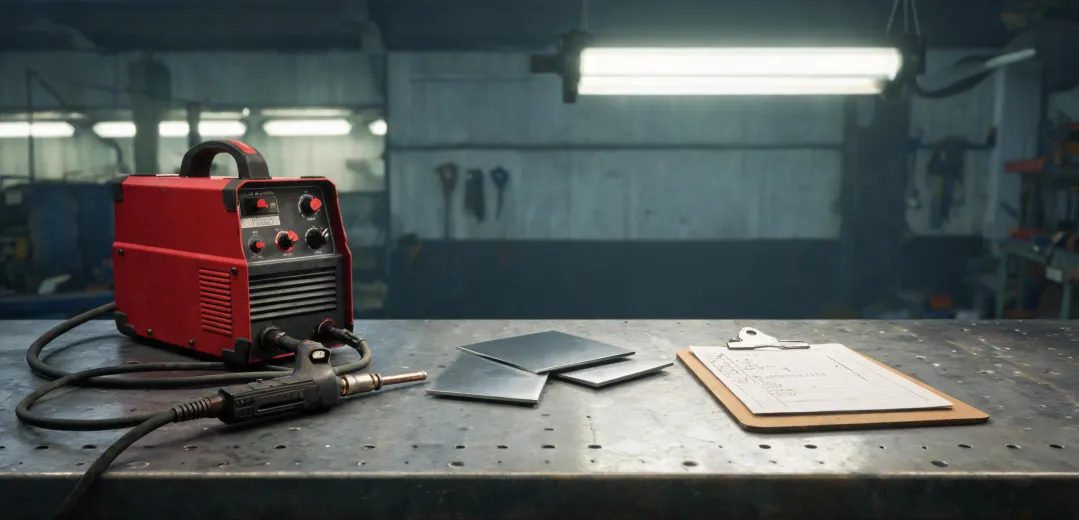
I'm the office administrator for a 180-person manufacturing company. I don't weld for a living, but I've signed off on welding equipment purchases for the last five years. When the production manager told me he found an old hobart welder generator for sale, my first thought was, 'Great—save some money.' That thought cost us more than the machine did (which, honestly, is a theme in this story).
The most expensive welding machine is the one that doesn't run when you need it.
The problem I thought I was solving
The shop needed a welder. That was the surface problem. A colleague searched 'old hobart welder generator for sale' because Hobart machines have a reputation. He found a big used unit for $900. It looked fine in the photos. It started when we went to see it. It even made a few decent beads on scrap. I approved the purchase.
Here's what I didn't realize at the time: I was buying a machine, not a certainty.
I manage about 60 to 80 purchase orders a year across vendors, and I report to both operations and finance. That position makes you sensitive to two things: cost and risk. When I took over purchasing in 2020, I was a price shopper. I thought my job was to get the cheapest thing that worked. I've changed my mind.
It took me three years and a pile of failed 'bargains' to understand that the cheapest machine is not the one with the lowest price. It's the one that runs when you need it. I didn't put that on a spreadsheet, but I should have.
The real problem: we never asked what the machine was for
The real issue wasn't the brand or the price. It was the question we skipped.
The most frustrating part of buying welding equipment is that the word 'welder' sounds specific. You'd think it would be enough. It isn't.
The MIG welder purpose is speed and ease on clean steel. Wire feeds continuously, no stopping to change electrodes, and you can get a decent bead without needing a degree in metallurgy. That's why a Hobart welder 135 makes sense for light repair work: it runs on 115 volts, handles thin steel, and is easy to move around.
But a Hobart welder 135 is not a production workhorse. It has a duty cycle. Every welding machine does. According to Hobart's product information, duty cycle tells you how many minutes out of a ten-minute period the welder can run at a given amperage before it overheats. That number matters more than the paint job.
If your job is precise, low-heat work, you may need a torch welding machine instead of a MIG. If it's outdoor pipe repair with rusty metal, stick might be the right process. Laser welding is another world entirely. The machine has to match the process, the material, and the load. We skipped that step.
The deeper reason we bought cheap is more uncomfortable: it's easier to defend a low price than a right price. In a company, a $900 purchase doesn't get questioned. A $2,400 machine triggers a conversation with finance. But no one asks why the $900 machine ended up costing $3,000 in downtime. That's the problem behind the problem.
An old Hobart welder generator for sale isn't automatically a bad idea. To be fair, Hobart built some genuinely tough equipment. There are machines from decades ago that still run every day. But when you're buying a 30-year-old generator, you're not buying the original machine. You're buying whatever 30 years of storage, wear, and maintenance—or lack of maintenance—have added. The seller usually doesn't know its full history. The buyer usually doesn't know until it fails.
The expensive part nobody invoices
The used generator failed on a Friday. Of course it did (surprise, surprise). It was running a job that needed more duty cycle than it could deliver. The machine shut down, the shop went quiet, and I had a $15,000 order with a Monday deadline.
Let's do the math I didn't do before buying:
- Used machine: $900
- Pickup and towing: $160
- Replacement parts and basic repair: $420
- Diagnostic time and labor: $300
- Rental replacement machine and freight: $410
- Overtime for four guys waiting around: $1,120
That's roughly $3,300 total—including the original $900—for a machine that didn't run when we needed it. The new, appropriately rated Hobart unit I eventually bought cost less than the total cost of that 'deal.'
When I compared our old used unit to a new Hobart side by side—same operator, same material, same amperage—I finally understood why duty cycle matters more than the nameplate on the front. The old machine started. The new machine kept running. That's the whole difference.
I don't want to pretend this is only about old equipment. I've also looked at China laser welding equipment when a client needed something faster than a traditional arc process. Some of those machines are genuinely good. Some are not. The country of origin isn't the problem; the lack of local support is. If you can't get a wiring diagram, a spare part, or a service technician in a week, you've bought a very expensive paperweight.
This is where my opinion gets strong: in an emergency, certainty is worth a premium. A rush fee of $400 buys a guarantee. A cheap machine buys a gamble. If you miss a $15,000 deadline because you wanted to save $400, the math isn't close. In March 2024, I paid $400 extra for next-day delivery on a replacement component. The alternative was missing a production deadline. I'd do it again.
What I'd do differently (short version)
I'd stop asking 'which welder?' and start asking 'what job will it do all day, and who fixes it when it breaks?'
My current checklist looks like this:
- What process fits the actual work? MIG for speed, TIG for precision, stick for dirty outdoor work, laser for specialized production.
- What duty cycle do I need at the amperage I'll actually run?
- What input power is available? A Hobart welder 135 is convenient on 115 volts. Larger machines need more.
- Who sells parts and service locally, and how long does a common part take to arrive?
- Does the seller offer any warranty or return window? Even 90 days beats 'as is.'
- If you're looking at an old hobart welder generator for sale: is there a maintenance log? Can you test it under load for 30 minutes? Can you put a load meter on it? If not, assume the worst.
Why I'll pay for certainty now
The way I see it, purchasing is not just about spending less. It's about making the operation predictable. A $2,500 machine with a warranty, a real spec sheet, and a local dealer is cheaper than a $900 machine that might fail on a deadline. That's not a sales pitch. It's the lesson from getting burned.
I'm not saying you should never buy used. I'm saying the decision should include the cost of being wrong. If you can absorb that cost, fine. If you can't, pay for certainty. The extra money buys the thing that actually matters: knowing the machine will run tomorrow.
If you're shopping for Hobart equipment—new or used—take the time to match the machine to the work. Ask what the MIG welder purpose is before you assume it's the right process. Think about whether a torch welding machine fits the application better. If you're tempted by an old hobart welder generator for sale, treat it as a project, not a production tool. And if you're comparing China laser welding equipment, judge the support plan, not just the price.
I don't have every answer. I've been doing this for five years, and I'm still learning. But I do know this: the cheapest purchase isn't the cheapest purchase. The machine that runs when you need it is the real deal. Everything else is just a story we tell ourselves to save money.