Two Requisitions Landed on the Same Day
Last January, I sat down with my coffee and found two requisitions on the same desk. One was for a commercial dishwasher that we planned to install for a catering customer. The other was for a TIG/stick welder for our own repair shop. They didn’t look related. That morning, I didn’t know they would end up teaching me the same lesson.
I’ve managed procurement for a 34-person company that refurbishes kitchen equipment and builds stainless steel fixtures for about six years. Our annual equipment and consumables budget is roughly $430,000. I track every order in a spreadsheet that has grown into our unofficial cost-tracking system. You’d think that would stop me from falling for a friendly monthly payment.
It didn’t.
Why I Needed a TIG Welder Nearby
We were building stainless steel tables for a food-service project. If you weld those with a standard MIG setup, you can scorch thin material and leave a rough surface. What the job needed was TIG welding with clean, sanitary beads.
Stick welding has its place. According to the American Welding Society’s classification system, E6013 is a stick electrode, not a TIG filler rod. We had three 10-pound boxes of Hobart 6013 welding rod in the shop, and that rod works nicely on mild steel frames and brackets. But on stainless food-contact surfaces, I did not want to guess.
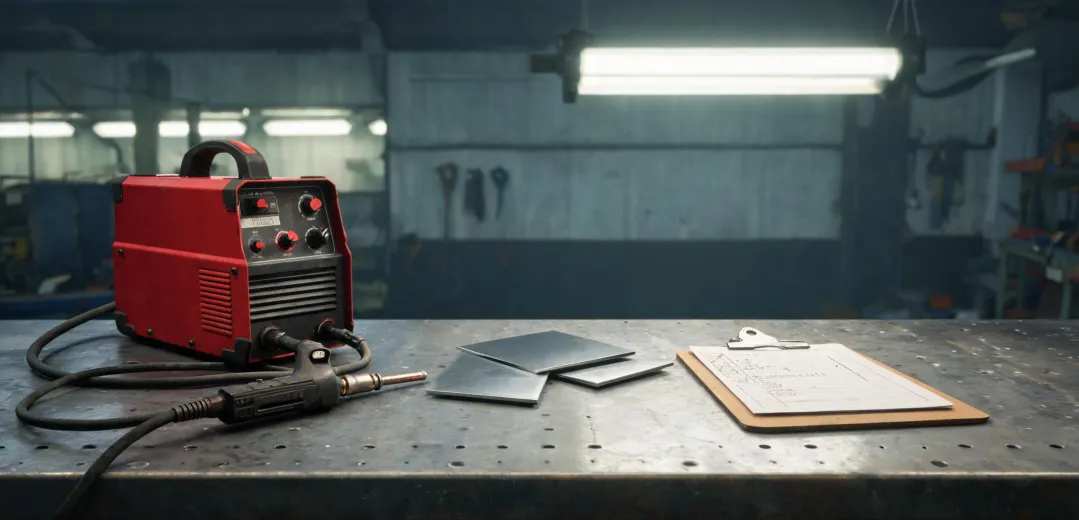
So I searched for a TIG welder that I could get fast. My search phrase was literally “TIG welder nearby.” The local dealer picked up the phone, and their machine with a TIG torch package came out to $8,550. That number made me hesitate enough to ask about financing.
When I Typed Lease Welding Equipment Into Google
I typed “lease welding equipment” for the same reason a lot of buyers do. A monthly payment feels easier than writing a big check. The dealer’s quote was $329 a month for 36 months. At the end, there was a fair-market-value purchase option. The entire pitch was built around how easy the payment would be.
Then I put it next to the purchase price.
329 x 36 = $11,844. If I added the buyout estimate of roughly $3,800 based on used prices, the total was about $15,600 for a machine I could have bought for $8,550. The lease also did not include TIG tungsten, filler rods, argon, or gloves. Those are consumables, but they still needed a line item.
Don’t get me wrong. A lease can be useful when a job is temporary or when cash is tight. But our shop had a steady pipeline. The longer we used this machine, the worse the lease math looked.
The Hobart Dishwasher Quote Changed My Perspective
While I was building that spreadsheet, our project manager asked me to approve a dishwasher quote. The machine was going into a catering kitchen that ran about 250 racks a day at peak. She had two numbers on the table.
One quote was from a brand I won’t name because the issue wasn’t the brand; it was my lazy way of comparing prices. The other was for a Hobart commercial dishwasher. The Hobart quote was higher. I nearly sent the purchase order for the lower number.
I stopped because of an ugly memory from 2021. I had signed off on a glasswasher with the cheapest parts service network, and the customer waited nine days for a pump. The equipment wasn’t bad. My decision process was bad.
So I started over and looked at Hobart dishwasher commercial models with an actual cost sheet. The quote difference was $6,100. But installation costs changed the story. The old dishwasher in that kitchen was a Hobart, so the water, electrical, and vent connections lined up with the new Hobart. The other machine would have required a different footprint and a plumbing revision. That added about $1,900 to the lower quote.
Then I compared water and energy use from the spec sheets. I don’t remember the exact per-cycle numbers now, but I entered them into my calculator and the yearly utility difference was roughly $1,050. That is about $7,350 over seven years, a normal ownership period for this type of machine.
Once I added the generic machine’s freight, startup, and two expected service calls, the 7-year total was more than the Hobart. The lower purchase price had disappeared. I was about to repeat the same mistake from the welding lease, just with a purchase instead of a lease.
Then the Sales Rep Showed Me a Handheld Fiber Laser
After I finished the welding numbers, the same dealer invited me to a demo. This is where I need to be honest. A fiber laser welding machine handheld is not a toy. It made my carefully planned TIG setup look old. One quick pass on thin stainless, no warping, no clean-up like a TIG torch, and the training curve was much shorter than I expected.
The quote for the fiber laser welding machine handheld was around $23,000. It would also need laser safety glasses, a fume extractor, and at least a few days of operator training. Our current volume didn’t support that price. But five years ago, that machine would not have been in the same building as our little shop. It was a reminder that the industry is changing.
I still approved the TIG machine. TIG still made sense for the stainless work we had booked. But I filed the laser quote under “revisit if volume grows.” If I had ignored the demo because it sounded like new technology, I would have missed a useful benchmark.
What I Did At The End
I bought the TIG/stick machine. Not because I love capital expense, but because I ran the numbers. I approved the Hobart dishwasher, then called the client to explain why the higher-priced option saved money over seven years.
Now our internal policy requires a one-page total cost sheet for any equipment request above $3,000. The sheet includes purchase price, installation, consumables, energy, service, expected life, and resale value. If a supplier offers a lease or rental, I put the monthly payment on the same page and convert it to a cost per month, not a magic number.
I also updated my search behavior. When I search for something like “TIG welder nearby” or “lease welding equipment,” I try to remember that local support matters more than the first quote. That doesn’t mean the most expensive option wins. It means the option with the best total cost wins.
To be fair, leasing has its place. If you face a short project, a low-usage niche process, or a cash-flow constraint, a lease may beat a purchase. The same is true for a cheaper dishwasher in a small cafe. This is not about brands. It is about matching cost structure to expected use.
My Bottom Line
I don’t trust my first reaction anymore. My first reaction was to lease a welder because $329/month looked harmless, and to buy the cheaper dishwasher because the number was smaller. Both decisions would have raised my long-term cost. I only caught them because I forced myself to compare total cost instead of initial price.
The prices I mentioned came from quotes I received in January 2025. They will change. The logic will not. Run the numbers, line by line, and make the decision you can defend when the invoice arrives.