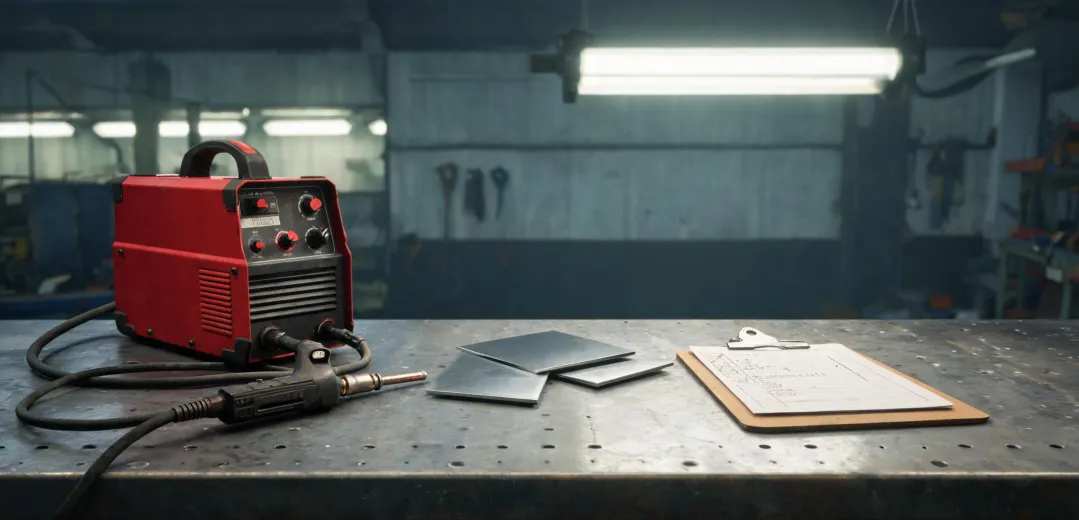
It was after 11 p.m. on a Friday in November 2023, and I was sitting cross-legged on the shop floor with the side cover off my Hobart Handler 125 welder. That little 115-volt MIG unit has been in our family shop since 2018. It's not glamorous. It just works. We use it for light stainless, mild steel brackets, and the occasional food-truck repair—the kind of welding equipment tools that don't sound impressive in a brochure but pay for the heat in the winter.
A week earlier, I'd told a deli owner I would build an 8-foot stainless prep table for her new Hobart meat slicer. She had saved for that slicer for two years. I know that because she told me twice. The slicer had the sharpener built into the top of the machine, and she considered it the centerpiece of her whole deli. The prep table had to be perfect, because the slicer was going to sit on it and be seen by every customer who walked in.
This was exactly the kind of situation I used to screw up.
The Week I Almost Blamed a Good Machine
The table itself wasn't complicated. Four legs, a reinforced frame, a 14-gauge 304 stainless top with welded corner joints. We do a lot of custom stainless work for commercial kitchens, so this was our bread and butter. Nothing exotic. The only challenge was the deadline: the deli owner had booked a kitchen contractor for a Saturday installation, and if I missed that window, her entire opening schedule shifted.
Midway through the week, with three days of welding left, the Handler started acting up. The arc was wandering. The wire feed sounded rough. My first instinct was to blame the machine—or rather, to blame the machine's age. It was five years old, and I'd put it through a lot. Maybe it was time for something bigger.
Then I remembered: the last time I had this exact problem, a new liner and contact tip fixed it in twenty minutes. That was the boring answer, so I ignored it for a day.
Instead, I did the thing I now tell every new shop owner not to do. I ordered a six-piece kit of generic parts for a MIG welder online at 1 a.m. The kit cost $38. Genuine Hobart parts would have cost $73, plus a 40-minute round trip to the welding supply store. I told myself the same thing everyone tells themselves: It's just a liner and a few contact tips. What could possibly be different?
The package arrived Thursday morning. I installed the liner, swapped in a fresh tip, and ran a test bead. It looked decent. Then I made a mistake: I trusted it.
By Friday afternoon, the Handler was birdnesting—wire balling up inside the drive roll like tangled Christmas lights. I pulled the liner out and found a kink near the gun end. The cheap liner was just stiff enough to bind as it heated up. Not terrible, not obvious, just almost right.
I also checked the contact tips I had installed the day before. The bore on those generic tips was slightly oversized, which made the arc wander and left inconsistent weld penetration. The beads looked fine on the surface. Underneath, they weren't.
I spent Friday night on the shop floor, teaching myself a lesson I should have learned years earlier.
What the Mistake Actually Cost
Here's what I remember most clearly: I had to call the deli owner on Saturday morning and cancel the installation. Not because the table wasn't done—it was mostly done. Not because the welds were visibly bad—they looked okay to the untrained eye. I canceled because I knew the welds weren't right, and I didn't want a health inspector or a skeptical contractor running a finger over a joint that would fail in six months.
I drove to the welding supply store on Monday morning and bought the genuine Hobart liner, contact tips, and nozzle. The whole repair took about twenty minutes. The difference was immediate. The arc stabilized. The feed smoothed out. I remade the questionable welds, delivered the table Tuesday morning, and paid my two guys overtime to help me catch up. All told, the cheap parts cost me about $380 in extra labor, one missed weekend, and a chunk of trust with a client who had every reason to lose patience.
The deli owner was gracious about it. The kitchen contractor was less gracious. I don't blame him. He had blocked out his Saturday for my installation, and I cost him a day he couldn't bill to anyone else.
The Slicer Sharpener Taught Me the Real Lesson
When I finally delivered the table, the deli owner was standing by the back door with a box cutter in her hand. She unpacked the new slicer and lifted it onto the table. Then she showed me the sharpener built into the top of the machine—two small grinding wheels under a little hinged cover, designed to bring the blade back to a consistent edge without removing it or taking the whole machine apart.
I'm not a knife sharpening specialist, so I'll be honest about my limits there. But I asked her why she chose that model with the built-in sharpener instead of a cheaper one that would need to be sent out for sharpening. She said something I haven't forgotten:
“I used to work at a deli where the slicer blade got dull and nobody noticed until the tomatoes came out ragged. Customers see that. They don't know why the slice looks bad—they just know it looks cheap. This sharpener keeps the edge the same every single day.”
She wasn't talking about welding. She was talking about the same thing I had just learned: quality is what the customer perceives, and the customer perceives every ragged edge.
The $38 generic MIG parts didn't fail loudly. They failed quietly, in the weld penetration. The kind of failure you don't see until a table leg joint cracks under a 70-pound slicer during lunch rush. That's when the deli owner doesn't blame the cheap parts. She blames the fabricator. And she tells other restaurant owners about it.
The Checklist I Use Now
It took me a while—and a few expensive mistakes—to understand that brand names don't exist to insult your budget. They exist because someone tested the part so you don't have to. That's true for a Hobart meat slicer sharpener, and it's true for a contact tip in a Hobart Handler 125.
- If a MIG welder starts feeding rough, check the liner and contact tip before you blame the drive motor or the ground clamp.
- Buy genuine parts for anything that affects weld quality or food contact surfaces. Generic parts are fine for clamps, wheels, and tooling you don't depend on. They are not fine for the one part that determines whether a weld holds.
- Take installation deadlines seriously. An on-time job with a small flaw is still a risk. A late job with clean welds is still late.
And yes, there was a moment where I convinced myself this whole disaster meant I needed to upgrade to a compact laser welding machine. I spent an evening watching videos of laser welders laying down beautiful beads on stainless. It was tempting. But the truth is, my old Handler wasn't the problem. A better machine wouldn't have saved a sloppy liner and an oversized tip. It just would have hidden them a little longer.
I still check the deli's table every time I drive past. It's holding up fine. So is the slicer, with its sharpener keeping every slice consistent. I'd like to think the table will outlast my embarrassment.