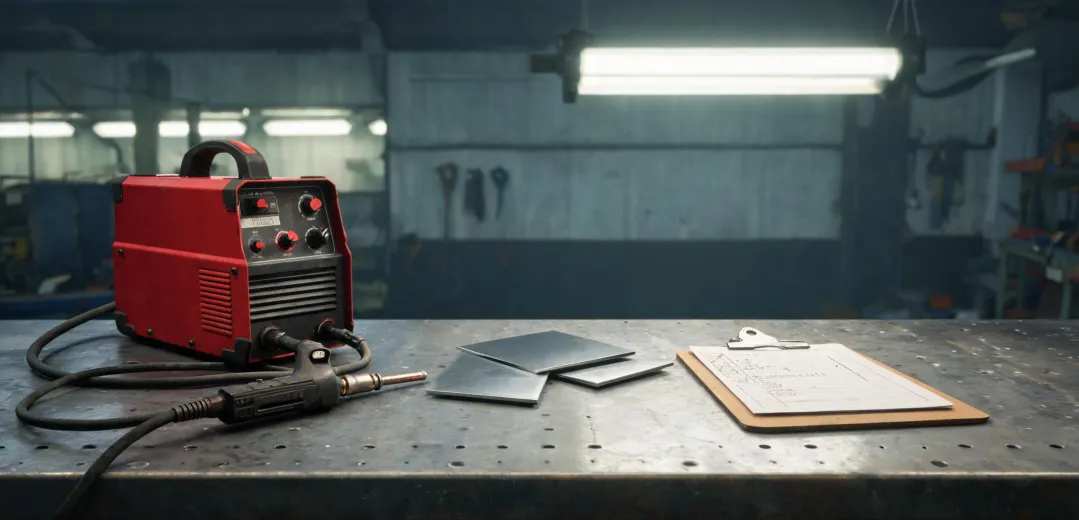
When I first got a request to buy a Hobart flux core welder, I did what any office administrator with no welding background would do. I said, 'Sure.' Then I closed my office door and searched the exact phrase. I wasn't sure whether 'flux core' was a type of wire, a type of machine, or both. It turns out it's a welding process, and that was the first of many things I had to learn.
The Request That Started It
I manage purchasing for a commercial kitchen service company. We repair foodservice equipment like Hobart dishwashers, mixers, and slicers. In a normal month I handle 60 to 80 purchase orders and manage eight or nine vendor relationships. I am not the welding expert; I'm the person who turns a request into a deliverable.
In early 2025, our service lead decided to stop outsourcing light stainless fabrication. Instead of waiting two weeks for an outside shop to make guards and brackets, we would do that work in-house. The idea made sense. The first request did not.
The request was short: 'We need a Hobart flux core welder on next month's order.' No model. No amperage. No mention of gas or accessories.
I asked the service lead which model he wanted. He said, 'The red wire-feed one we had at my last job.' I smiled and pretended that was enough. Then I spent an hour staring at TIG welder pictures, because I wasn't even confident enough to know what a TIG machine looked like.
The search was not a waste. It taught me that TIG welding and wire-feed welding are not the same. TIG uses a tungsten electrode and a separate filler rod. A wire-feed welder pushes a continuous wire through the gun. One is precise craft. The other is a practical way to get repair work done. Neither is automatically better; it depends on the job.
Why I Called a Hobart Welder Parts Dealer
Before I typed a purchase order, I thought about a problem from 2022. I bought a small batch of replacement parts from an unfamiliar vendor because the price was lower. The parts worked. The invoice did not. It had no PO number, no line-item tax breakdown, and the wrong remit-to address. Finance rejected the expense. Since I had approved the order, it came out of my department budget. It was not a disaster, but it made me look like I had no process.
So instead of searching for the lowest price, I searched for a Hobart welder parts dealer. I used Hobart's dealer locator in January 2025 and called the shop closest to our area. The first person who answered asked a question no online listing asked: 'What are you going to weld?'
I said stainless steel guards and brackets. He asked about metal thickness and whether the welding would happen inside the shop or outside. He asked whether our team had used a wire-feed machine before. Then he recommended a machine I had not considered. He also added, 'If a seller tells you one machine does everything, call someone else.' That is advice I have not forgotten.
Two Machines We Considered and Didn't Buy
A senior technician wanted to buy a used SA200 welding machine. He had spent years running a classic SA200 welding machine in pipeline work. He could produce welds that looked like stacked dimes. But when I looked into buying one used, I could not ignore the support question. We could find an SA200 welding machine for sale. Finding someone local who knew how to service the generator was another story. I don't doubt the machine. I doubt our ability to keep it running after the local old-timers retire.
The other distraction came from the service lead. He sent a video of an aluminum laser welding machine. The welds looked clean and fast. He wanted to quote aluminum railing repairs. I nearly added it to the next budget review. Then I looked at what it takes to own an aluminum laser welding machine: specialist training, a controlled work area, and a price tag much bigger than our annual welding supply budget. We had received exactly three aluminum jobs in the previous year. We sent those jobs to a shop that specializes in that process. That is the boundary I mean: know what you're buying and what you are not.
What We Actually Ordered
The order that finally went out was for a Hobart Handler 210 MVP. It is a wire-feed welder that can run self-shielded flux-cored wire without a shielding gas bottle, and solid wire with shielding gas for jobs where a cleaner weld matters. For our stainless guards and mild steel brackets, this was the right size.
The dealer also added a gas nozzle kit, extra contact tips, wire liners, and a cylinder cart. He registered the warranty and put the serial number on the invoice before shipping. That might sound boring, but for me, the serial number on the invoice is the difference between a clean audit and a four-hour headache.
Within the first two months, we fabricated several replacement guards and shelving units that would have been outsourced. That did not make us a production fab shop. It made us a faster repair company, which was the goal.
The Real Lesson
The real lesson is not about choosing a red machine over another brand. It's about who can support the machine after the glossy unboxing video ends. Price is easy to compare. Pictures are easy to look at. A machine's personality is easy to fall for. What's hard is knowing whether parts, training, and support will be there in six months.
I still do not fully understand why people search for TIG welder pictures when they should be searching for process comparisons. My best guess is that most of us start with pictures because we don't know enough to form a question. Pictures help identify equipment. They don't tell you if it fits your work. Only a conversation with someone who knows the product can do that.
Did the Hobart flux core welder solve our problem? Yes. Not because the equipment is magic, but because we bought it through the right process. A real dealer, a clear spec sheet, consumables, warranty registration, and clean paperwork. That is what I would tell any administrator who suddenly has to buy a welder. Start with the machine your work actually requires. Then find the people who can support it. The red paint is secondary.