On November 14, 2017, I was standing in my shop looking at a Hobart commercial mixer with a snapped support bracket. The customer needed it running by the following Monday. I told him I’d call Sal, the welder I’d used since 2014, and get back to him.
Sal didn’t answer. That should have been the first sign.
He texted me at 7 PM: three weeks out, no way to squeeze me in. The customer called at 8 PM asking if there was any other option. “I’ll take care of it,” I said, with zero idea how.
That’s when I made the mistake that cost me more than a new welder. I decided I didn’t need a welder who knew what he was doing. I could just buy a welder.
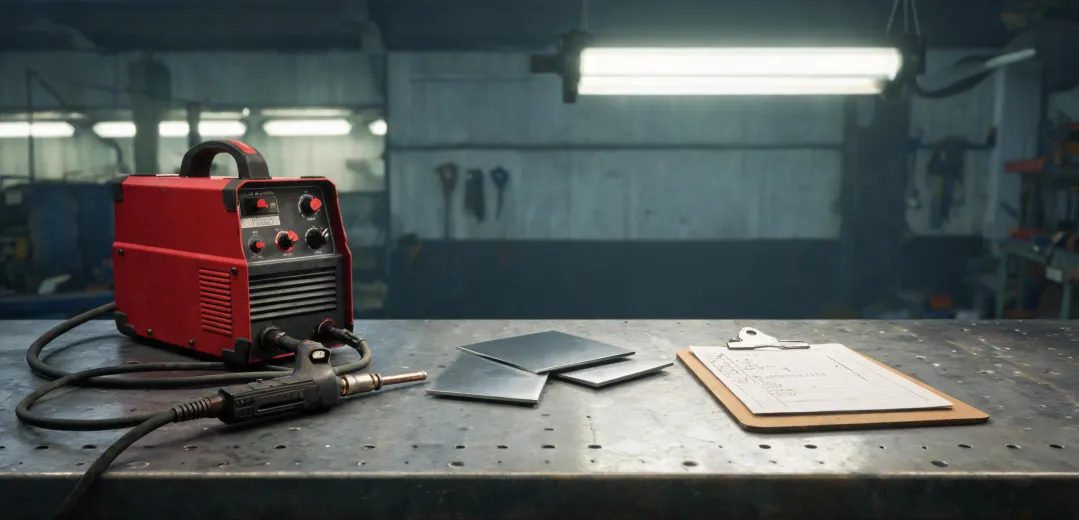
The $289 “Gun Welding Machine”
Here’s a true thing about small repair shops: when the job depends on a tool you don’t own, you don’t think straight. I sat down that night, Googled “mig welder machines,” sorted by price, and started scrolling.
The listing that caught my eye was a 130-amp MIG/flux-core unit with a photo of a clean weld bead and a description full of words like “industrial-grade” and “professional.” The price—$289, marked down from “$429”—felt like a no-brainer. The reviews were mostly from other beginners posting their first projects. Their welds looked fine.
The question everyone asks is “how much?” The question they should ask is “what’s the duty cycle?” It’s the difference between a tool you can work with and a toy that takes frequent timeouts. This machine’s spec sheet claimed 35% at 90 amps. That’s about three and a half minutes of actual welding before the thermal overload shut it down for six minutes of cooling. I knew none of this at the time (note to self: duty cycle first, price second, always).
And yes, the listing literally called it a “gun welding machine.” That phrase should have been a red flag. A MIG gun is a precision component, not a toy accessory. But I was an amateur reading amateur reviews, and I saw what I wanted to see.
The Cart That Collapsed
The machine arrived four days later, shipped via USPS in a box that seemed noticeably heavier than the machine it contained. I unpacked it, ran a few test beads on scrap steel, and felt pretty good about myself. The welds looked okay. The wire feed occasionally stuttered, but I assumed that was my technique, not the machine.
A few weeks later, a bakery asked me to build a custom cart for their hotel pans. It was a $3,200 order. I cut the steel, welded the frame, painted it, delivered it. Three days of work. The welds looked clean: no spatter, no drips. I photographed it for my portfolio and went home feeling like a hero.
Two weeks later, the bakery owner called me. The cart had partially collapsed. One of the lower shelf brackets had snapped clean at the weld. A full hotel pan of proofing dough hit the floor and splattered across her kitchen.
The broken bracket told the real story. My weld had barely penetrated the parent metal. The stuttering wire feed had produced cold welds—beads on top of the joint that looked fused until they weren’t. It’s a classic failure mode for cheap MIG machines, one that any experienced welder would have caught in ten seconds. I caught it by losing a customer’s trust.
I paid a local fabricator $900 to rebuild the cart properly. The welds he laid down were clean, consistent, and permanent. I refunded the customer’s entire $3,200 order. She stayed with us, thank God, but it took months to rebuild that relationship.
Then I tried to return the welder. The seller’s “free returns” label covered about a third of the shipping cost. For a 60-pound package, USPS ground was an extra $38 out of my pocket (I still have the receipt). Per FTC guidelines (ftc.gov), advertising claims have to be truthful and substantiated. But that listing had already disappeared, along with the seller. Good luck enforcing anything.
The whole disaster cost me more than $4,400. Let me say that again slowly: more than four thousand dollars. On a “savings” of $611.
The Hobart 220 Volt MIG Welder
The Monday after everything fell apart, I drove to a real welding supply shop. The place smelled like ozone, cutting oil, and floor wax. The guy behind the counter looked at the photos of my failed welds and said, “You bought a toy, not a welder.” He wasn’t trying to be mean. It was just the truth.
Then he pulled the spec sheet for the Hobart Handler 210. I noticed the voltage first: 220 volts. My shop already has a 220V outlet for the air compressor, so the machine could plug straight in. The duty cycle was listed in plain, honest numbers. The wire feed used a grooved steel drive roll. The MIG gun felt like it belonged in a professional shop—because it did.
I asked about laser welders too. I’d spent a couple of nights reading about laser welding machine components—resonators, cooling loops, focusing optics—and it sounded like learning a second language. The counter guy shook his head.
“You’re a kitchen equipment repair tech,” he said. “You need welds that hold, not a physics experiment.”
He was right. And that’s the point, I think. I’d rather trust a specialist who knows their limits than a generalist who overpromises. Hobart is exactly that kind of specialist. They build commercial kitchen equipment—mixers, slicers, dishwashers—that survives a decade of daily abuse. Then they build welders for the same kind of customer: professionals who need equipment that works on Monday morning.
I bought the Handler 210 that day for just shy of $900, and the difference was visible from the very first bead. The arc stabilized instantly. The wire fed smoothly and evenly. I could weld continuously for half an hour without the thermal overload light blinking at me like an accusation. The welds penetrated. I didn’t feel like a hero. I felt like someone with the right tool for the job, which is a much better feeling.
What I’d Tell Anyone Buying Their First MIG Welder
To be fair, the $289 machine did teach me one valuable lesson: why professionals buy from professionals.
Looking back, I should have bought the Hobart 220 volt MIG welder from day one. At the time, the price difference felt huge. But the math was brutal—$289 for the welder, $38 in return shipping, $900 for a fabricator to redo my work, $3,200 refunded to a customer who almost walked away. Over four thousand dollars, versus nine hundred. Don’t hold me to the exact numbers, but the lesson holds.
If you’re comparing MIG welder machines right now, I get it. The price difference is super tempting. A cheap gun welding machine seems like a great idea until it fails on a job that matters. If you ask me, the cheap option stops being cheap the moment you need it to perform under real-world conditions.
I still repair Hobart kitchen equipment every day. I still weld from time to time. And the Handler 210? Still on the job, seven years later, starting up every time without complaint. The welds it makes are boring, consistent, and permanent. Boring is exactly what you want in a commercial kitchen.
Bottom line: don’t buy the wrong welder first. I did, so you don’t have to.