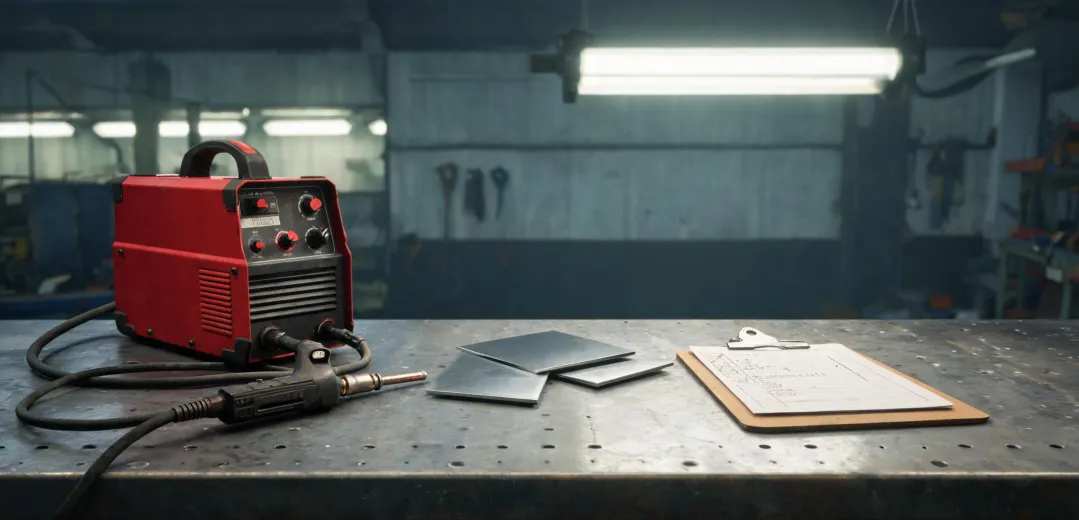
We didn't need a bigger machine. We needed a certified welder. I learned that in September 2022, about $6,800 and three lost weeks later.
The machine itself wasn't the problem. We bought a Hobart 187 MIG welder, and it's a solid unit—not a toy, not a production monster, but a serious tool for light-to-medium steel fabrication. For the first few years we owned it, the 187 was never the reason a job went sideways. The reason was always the system around the machine.
If you've ever watched an inspector run a gloved finger over a weld and then ask for paperwork, you know exactly what that does to your stomach. The weld can look perfect. The invoice can be perfect. The paperwork is still what gets you paid.
The Problem That Looks Like a Machine Problem
Ask any welding forum why a test weld failed, and the standard answer is equipment. Buy a heavier machine. Buy a different feeder. Buy the next model up. Is there some truth to that? Sure. A weak, undersized machine can absolutely hold you back.
But in code work, the machine is rarely the bottleneck. The code doesn't certify brand names. The operator gets qualified. The procedure gets qualified. The machine just holds an arc steady while the welder does the rest.
What Was Actually Going On
Looking back, three separate issues were hiding behind one purchase decision.
1. A mig welder certificate belongs to a person, not a machine
I'm not a welding engineer, and I don't write welding procedure specifications. If a job references a code I don't work with daily, you should get a certified welding inspector involved. What I can tell you from the buyer side is where my money went wrong.
People search for 'mig welder certificate' like it's a product you can buy along with the machine. It's not. The phrase usually means a welder performance qualification record. That document lists the person's name, the process, the position, the base material, and the filler metal.
A welder earns that record in a test booth—bend tests, visual inspection, sometimes more depending on the code. It travels with the welder, not with the machine. If your best employee can't produce that record, a newer MIG unit will not fix it.
2. MIG welding is a loop, not a box
From the outside, a MIG welder looks like a box that pushes wire. From the inside of a weld, it's a loop. Voltage sets arc length. Wire feed speed sets current. Gas flow protects the puddle. Gun angle, travel speed, contact-tip distance, and base material cleanliness all decide whether the weld actually fuses.
Change one variable and the result shifts. A new machine doesn't clean mill scale off the steel. It doesn't choose the right wire or shielding gas. It doesn't hold the gun at a consistent angle for you. This is why two shops can buy the same model and get completely different results. Same brand. Same machine. Different systems around them.
3. The brand halo effect hit me right in the wallet
Before the welding side of our business existed, I spent years working with commercial kitchen equipment. In that world, the Hobart industrial dishwasher is about as close to bulletproof as equipment gets. Restaurants buy them, run them hard, and don't think about them again. That reputation is earned.
So when we launched our fab shop, I defaulted to trust. Hobart built tank-like kitchen machines, so a Hobart welding machine felt like the safe bet. I didn't separate equipment durability from process output. A machine can run for twenty years and still produce bad welds if the person running it was never qualified.
Here's the part that should have triggered me sooner: a Hobart dishwasher still depends on water temperature, chemicals, correct racking, and maintenance. Get those wrong and you don't get clean, sanitized dishes. The machine is necessary. It's not sufficient. Welding is the same.
The Real Cost of Confusing a Tool With a Certificate
In September 2022, we took a contract for stainless steel handrails at a restaurant renovation. It was the kind of job I knew well from my kitchen days—except this one had a clause on page four requiring weld documentation.
I read 'weld documentation' and thought, no problem, we'll take photos. The general contractor meant a WPS and welder performance qualification records.
Our lead welder had twelve years of experience in shops that never asked for paperwork. In the test booth, his groove weld failed the guided-bend test. Not because the Hobart 187 was weak. Because he had never practiced or tested for that type of weld under those conditions.
The total damage was about $6,800 when I counted lost margin: testing fees, rework on sections that couldn't ship, and the rest of the contract going to a shop that already had qualified welders on staff. On top of the money was the timeline. Four weeks of training and retesting. A relationship with a general contractor who stopped returning calls quickly.
After that, I built a checklist. We've used it since Q1 2024 to catch qualification gaps before work starts. Not one of those gaps was solved by buying a newer welder.
The Short Version: What I'd Do Now
If I could walk back to 2017 and redo that purchase, the checklist would be short.
- Find the acceptance criteria before you find the machine. If a contract references AWS D1.1 or another code, have someone code-literate review it before you buy consumables. Let the acceptance criteria drive the process and equipment class.
- Choose the process by the work, not by the brand name. Clean, light-to-medium steel and production speed? A 187-class MIG with solid wire and shielding gas is a reasonable pick. Heavy plate, rusty steel, or outdoor repairs? A 225 welding machine running stick electrode often earns its keep faster. Both are legitimate. Neither replaces qualification.
- Budget for qualification before the machine. In our area, a third-party weld test runs a few hundred dollars plus materials. Budget for two attempts, because nerves and lack of practice are real. That line item is not optional if you plan to do commercial work.
- Consider automation early. If the same weld repeats a thousand times, talk to an automatic welding machine supplier before adding another manual machine. A robotic or automatic cell holds travel speed and torch angle far more consistently than a person can over a ten-hour shift. It still needs a qualified procedure, but it removes most of the human variables that fail weld tests.
- Train and test before the deadline, not after it. Structured practice at a place like the Hobart Institute of Welding Technology in Troy, Ohio, can help. So can local community college welding programs. Use them before the inspector shows up, not after.
I still run the Hobart 187. It's a good machine. If someone asked today whether they should buy a Hobart 187 MIG welder, my honest answer would be yes—if it fits their material and their power setup. Just don't ask the machine to do the part of the job you have to do.
The industry has changed. In 2015, a handshake and 'we've been welding for years' might have been enough. By 2025, contractors want an auditable process: documented procedures, qualified welders, traceable materials. Some fundamentals stay the same—clean metal, correct settings, and someone who has proven they can lay a sound weld.
Buy the machine. Then do the boring part first. That's where the certification actually comes from.