After three years of managing equipment purchases, I've learned one thing the hard way: in commercial equipment procurement, the lowest upfront price is almost always the most expensive choice. That's not a business-book theory. It came from spreadsheets, a few costly mistakes, and one gut call that saved me from a disaster.
I'm the office administrator for a 150-person company. I manage all equipment ordering—roughly $450,000 annually across about 8 vendors. I report to both operations and finance, which means I get squeezed from both sides: operations wants reliability, finance wants savings. My job is to find the middle ground.
The equipment I buy spans two very different worlds. One is our central kitchen—Hobart restaurant equipment like dishwashers, mixers, and slicers. The other is our facilities maintenance team—MIG welders, plasma cutters, and thermoplastic welding machines. Sounds unrelated. But both taught me the exact same purchasing lesson.
Argument 1: Downtime Cost Is the Real Comparison Baseline
When I took over purchasing in 2020, I made a decision that looks naive in hindsight. Our commercial dishwasher needed replacing, and I chose an off-brand unit that was about 35% cheaper than the Hobart equivalent. I stared at that price comparison sheet and thought I'd negotiated a great deal.
Within 14 months, that dishwasher broke down at least once a week. Not counting repair costs, each breakdown delayed dish turnaround by at least 90 minutes. Sounds manageable? We process about 2,400 covers a day. Those delays meant overtime pay, temporary disposable serviceware, and complaints from the front of house.
In year two, we switched to a Hobart machine. The price was 35% higher—or rather, the gap was closer to 12% once you factored in the extra operating costs the off-brand had generated. That Hobart unit has been running for over three years with only routine maintenance.
To be fair, the cheaper brand has a market. If your operation is small—say, three or four days a week, low volume—downtime might not hit you the way it hit us. But if you're running 12+ hours a day, in my experience, the brand premium pays for itself fast.
Argument 2: The Training Ecosystem Nobody Factors In
Last year, our facilities team needed to handle a batch of newly installed HDPE piping. That meant thermoplastic welding—specifically, butt fusion welding. At the same time, we were evaluating whether to bring some metal bracket fabrication in-house, which would require a MIG welder.
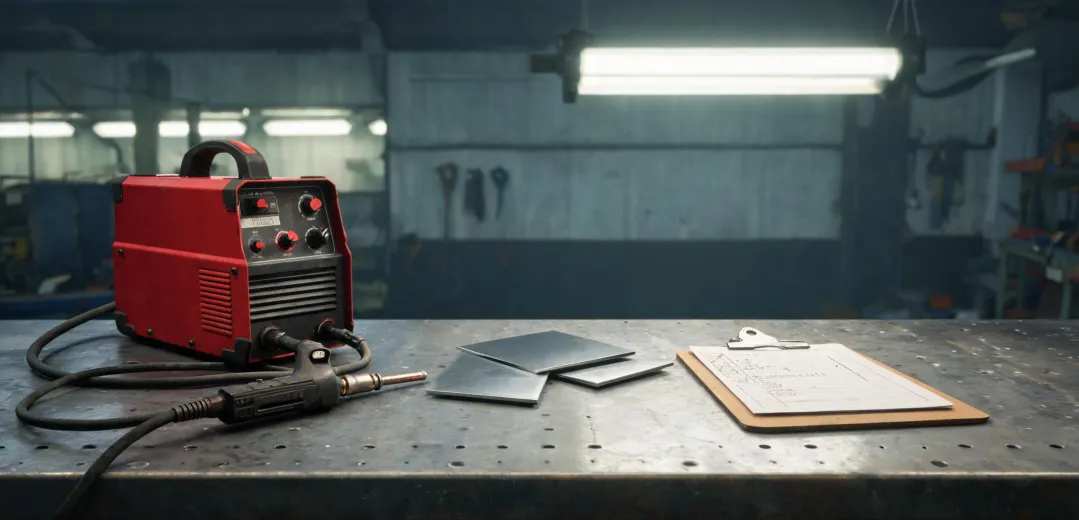
My team suggested a Hobart 125 wire welder for entry-level MIG work. I hesitated at first—it looked like a small machine, not the "industrial" thing I'd imagined. We also looked at lease welding equipment options, the kind where you rent rather than buy outright.
Here's the thing most people (including me at the time) overlook: the real cost of welding equipment isn't the machine. It's training, consumables, and ongoing support. Hobart has a complete training and consumables ecosystem—their Welding Institute resources cover most basic scenarios. When you lease, you typically get the hardware only. Training is on you.
From a risk perspective, leasing welding equipment makes sense for short-term projects or proof-of-concept phases. When we trialed our thermoplastic welding machine, we leased first for two months to validate feasibility, then committed to purchase once we confirmed volume. But if you have long-term demand—especially involving certified processes like pressure-rated thermoplastic welding—a brand with a built-in training pipeline will save you headaches. It costs more upfront. It costs less later.
One more detail I spent way too long figuring out: when you search "best welder MIG," most rankings and reviews are written for hobbyists. Commercial requirements are completely different—duty cycle, continuous operation, consumable swap time. Those metrics rarely show up in personal reviews.
Argument 3: The Total Cost of Ownership Exercise I Force Myself to Do
My current rule: for any equipment purchase over $2,000, I build a three-year total cost of ownership sheet. It includes:
- Purchase price (or total lease cost)
- Projected maintenance and consumables (based on manufacturer failure-rate data, not sales scripts)
- Estimated cost of downtime or efficiency loss
- Operator training time
- Residual value loss if early replacement is needed
I have not yet encountered a single case where the cheapest option also had the lowest total cost. That said, this conclusion mainly applies to high-intensity commercial use. If you only run equipment a few times a year, maintenance and downtime costs are negligible—the cheap option really is fine.
One near-miss proved this to me. A new supplier quoted about 40% below our current channel—specs looked comparable on paper. Every spreadsheet analysis pointed to switching. I spent two days on the comparison. All the numbers said: save the money.
But something felt off. Their communication was slow—not "takes a day to reply" slow, but "send three emails to get one answer" slow. I asked around. A contact in the industry told me this company had multiple delivery delays exceeding six weeks. I didn't switch. Six months later, I heard their lead times had stretched from a promised four weeks to ten. Several customers were scrambling for alternatives.
So glad I trusted that instinct over the spreadsheet. Almost traded our entire operational rhythm for a line-item saving.
When I Wouldn't Recommend the Brand-Name Option
I'm not saying "always buy the expensive brand." That's too simple. In my opinion, here's when going cheaper is genuinely the smarter call:
- Low usage frequency — backup equipment used a few times per quarter, or seasonal-only machines.
- Fast technology cycles — if a category refreshes every two years, buying a cheaper newer model may beat buying a mature name-brand unit.
- Non-critical processes — if failure doesn't directly impact customer delivery or revenue, fault tolerance is much higher.
- Short-term projects — anything under six months, leasing or budget alternatives are often more rational.
If you're in one of these buckets, you might be in that 20% where the brand premium doesn't pay off. I'm not going to push you toward it.
Where I Stand
I'm not selling a brand. I'm advocating for a framework: before concluding that "the expensive one isn't worth it," put the brand premium and the total cost of ownership on the same sheet.
But flip it: if your scenario really is low-usage, low-risk, short-cycle—be honest about that and pick the budget option. There's no shame in it. What's shameful is paying for durability you'll never use, or saving small money upfront and dragging your operation into a cycle of constant firefighting.
Granted, this takes extra analysis time. But I can tell you—the cost I paid in 2020 for skipping that analysis (roughly $8,000 in extra operating costs from that dishwasher, plus the repair bills I ate from my department budget) has long since exceeded every hour I now spend building total-cost sheets.